
Large browns and windblown terrestrials: A Day on the River Kennet at Benham Park
There are days on our southern chalkstreams that we plan for meticulously, sometimes months in advance, and then there are days that rather spring up on you, complete with that magic combination of fishing and good company that might just make something memorable happen. Back in August, I dragged my friend and fellow guide, Freddie, out for a day on the River Kennet, at Benham Park, for a flavour of the latter.
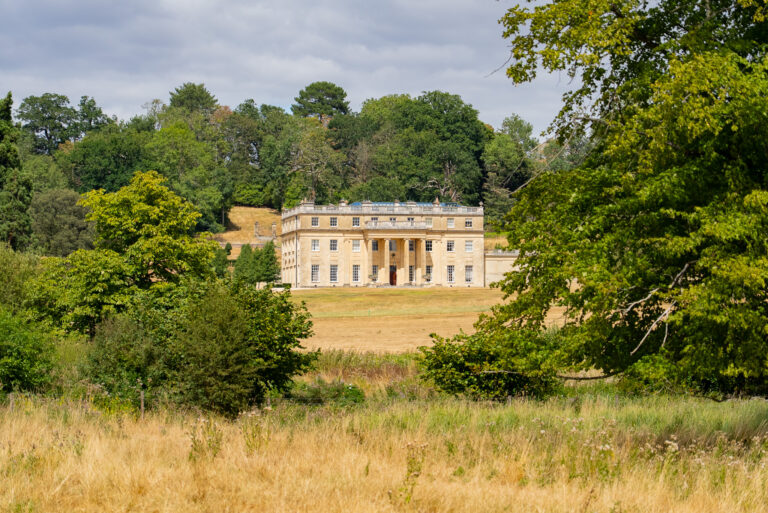
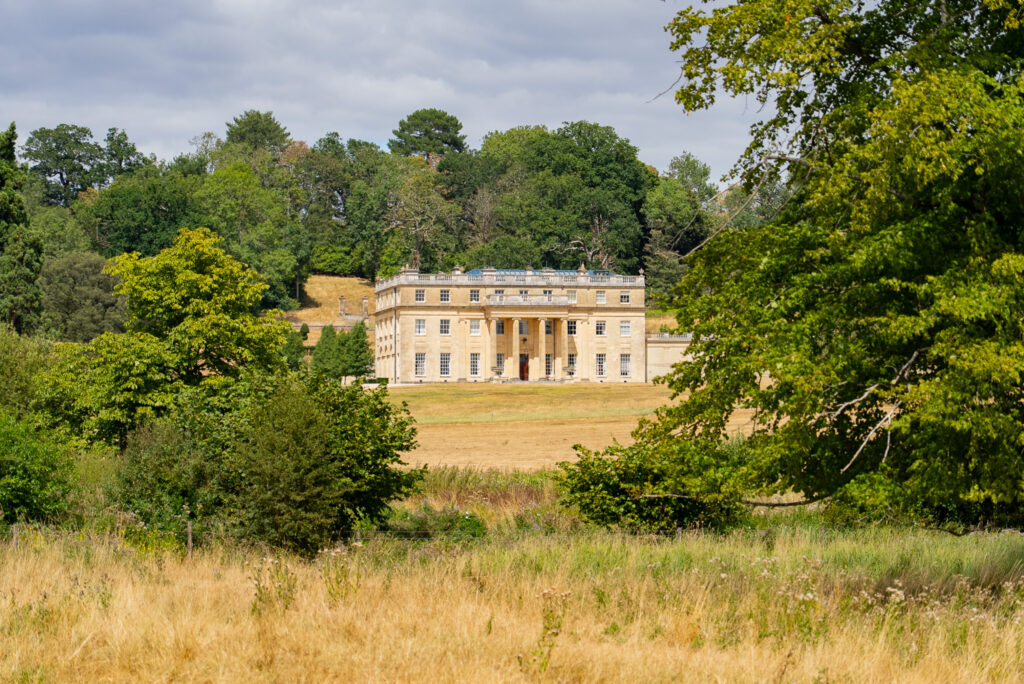
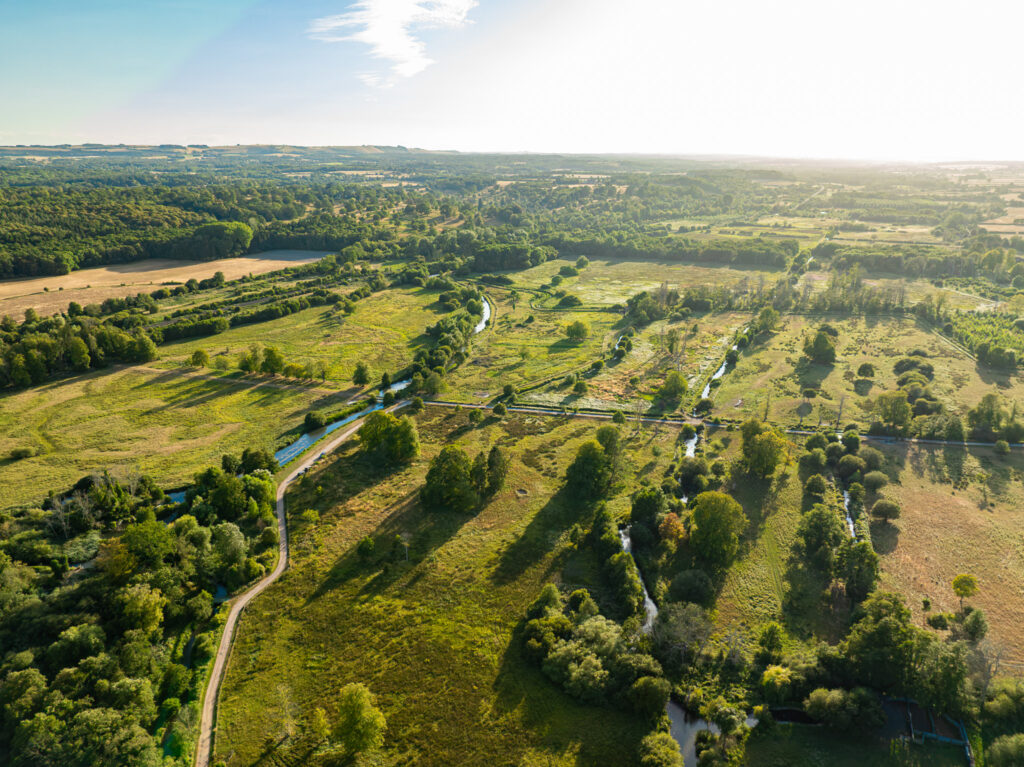
Benham Park, or Marsh Benham as it is also known, needs no introduction in the chalkstream circles. Just 5 minutes west of Newbury, the estate is one of the jewels of the river Kennet, with several miles of main river and carrier streams that weave through the parkland, overlooked by a gorgeous stately home. Great Oaks stand scattered across the water meadows, and as we drove down towards the river, the fields either side of the track were dotted with sheep and cattle grazing throughout the grassland. It is the kind of old-money setting that oozes quintessential English countryside. Indeed, it is a landscape designed by the hand of Capability Brown.
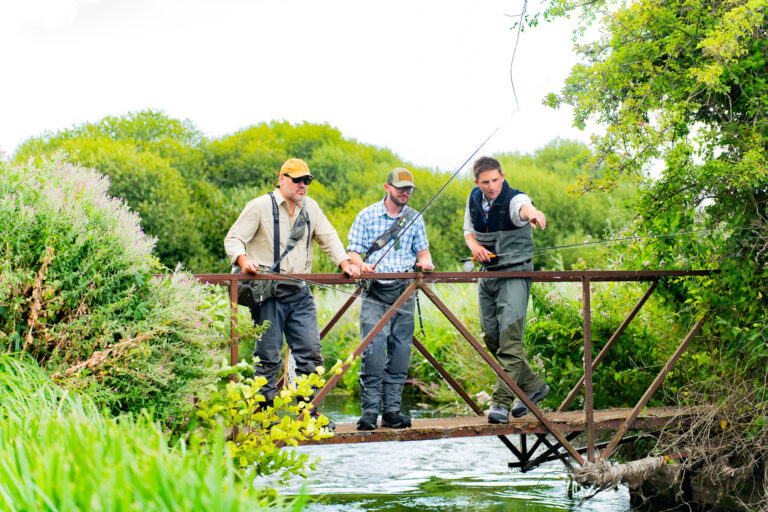
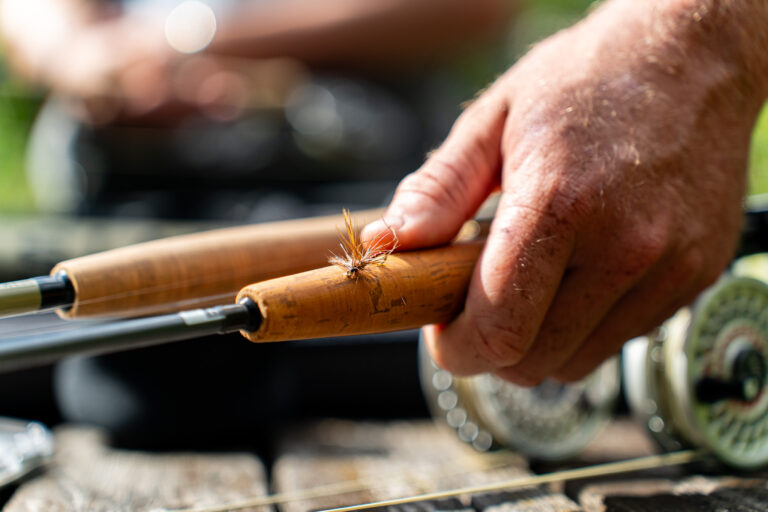
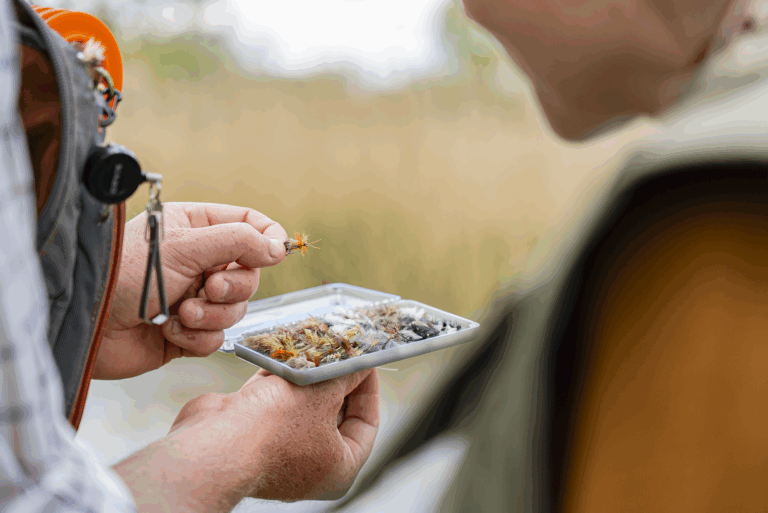
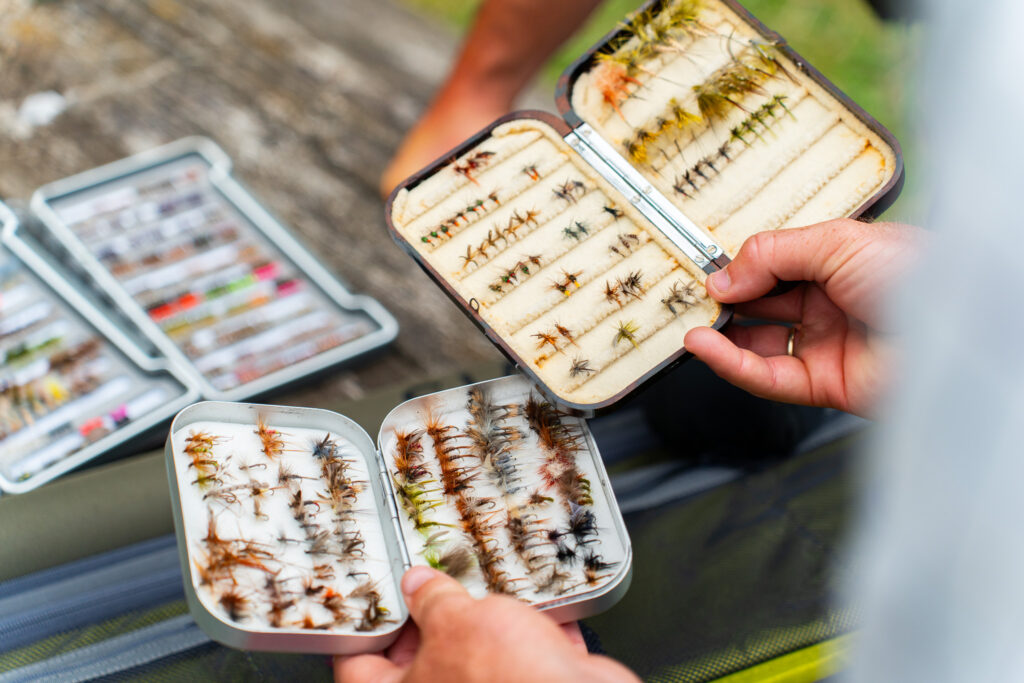
Freddie’s grandfather held a half rod at Benham many years ago, but that was about the sum of his experience on the beat, so as the appointed guide for the day, the responsibility to conjure up a plan fell squarely with me. My friend and videographer, Damon, had joined us to film and photograph the day, so whilst he set about rigging cameras and rooting out vantage points along the riverbank, the two of us strung up our rods and commenced the obligatory deep dive into each other’s fly boxes. Contrary to Damon’s best efforts, I am not a natural in front of the camera, but it was strange in a nice way to have a lens documenting a day that would otherwise have been lost in the folds of whatever half-true fable I told in the pub afterwards.
With pleasantries out of the way, the plan was to work upstream through the morning while the fish might still be looking up, then reassess at lunch once the heat had properly set in. Given the forecast, warm with blustery winds, none of us were entirely sure what to expect. Chalkstream brownies can be maddingly particular about presentation even on a calm day. Now, add wind-knots, tangles, and stubborn tippets determined not to turnover, and you’ve got a recipe for a very tricky customer!
Part of what makes Benham such a special place to guide is the vast variety of fishing on offer. The main beat is broad and generous, with long glides and deep pools, perfect for beginners and entertaining guests. But it is the carrier streams that, for me, are the real heart of the fishery. The Duckwood, Pound and Lamb streams, in combination with Parliament Draft and of course the Main River, amount to an enormous 5 miles of unadulterated trout heaven. Parts are narrow and intimate, demanding a tricky bow and arrow cast on two knees, or a careful roll just to get a fly anywhere near a fish without spooking it. Some are shallower and faster, gravel runs where the trout hang close to cover and dart out to anything drifting past. Others suit longer casts, plopping your fly in the seams and creases where a big brown will sit up out of the main flow.
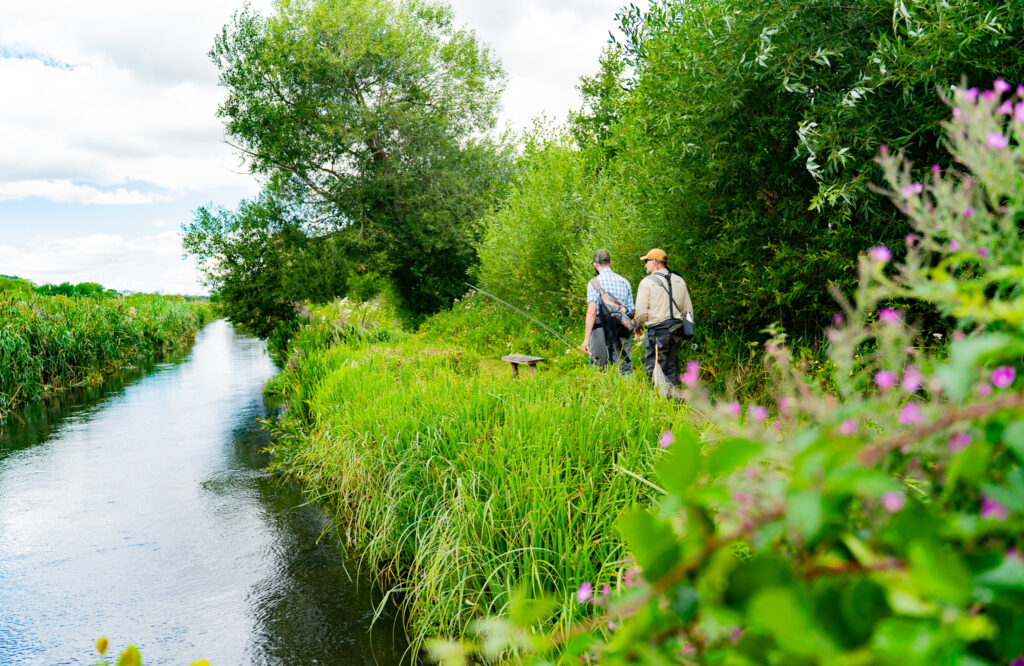
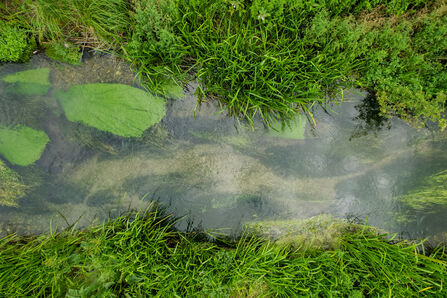
Tackled up, we gunned for the Lamb stream, a long, straight-as-an-arrow carrier which is about 10 to 15 feet wide, 2 to 3 feet deep, and quite pacey. The fishing there is single bank, with an archaic deciduous woodland behind you, and nothing but high reeds and water meadows opposite. Gary, the river keeper of nearly 35 years, does a splendid job of managing the marginal fringes so that whilst there is plenty of cover, the casting is fairly easy-going. In July and August, the blindingly vibrant purple loosestrife chequers the riverbank, and all around you are heady smells of watercress, meadowsweet and hemp agrimony. Beneath the water, swathes of ranunculus and ribbon weeds riffle gently in the flow. It truly is beautiful.
The call we made early on, and I think the one that went on to define the day, was to go up a few sizes in the tippet department. Where we chalkstream veterans would usually reach for something fine and supple to fool a Kennet brownie, such that it collapses on the surface with no disturbance and no drag, the blustery conditions simply wouldn’t allow it. The headwind, blowing as it did precisely downstream, meant that any attempt to cast a fly upstream morphed into more of a frustrated punch. In the nautical world we call this point of sail a ‘close haul,’ and indeed it took a double haul to force the line into wind with any real conviction. A slightly stiffer tippet, the difference between 4x and 3x perhaps, just helped unfurl the rigging that little bit more reliably. Better a fly that lands where you intend it, with fractionally less delicate presentation, than a fly that never gets there at all.
The first pool we fished, a long glide below an overhanging alder, proved our theory almost immediately. Lost in our meandering ramblings, Freddie and I sleepwalked straight into our first opportunity, practically tripping over a large trout that was sitting up maybe six inches beneath the surface. He was tucked into the softer water where the alder branches brushed the surface, bouncing rhythmically in the current. It was tight, we agreed.
To our complete bemusement, our new friend of maybe 2lbs rose almost immediately to inspect a leaf adrift in the flow. Gulp! He slurped it up. Quite unbelievably, this brown trout had plucked a leaf off the surface in front of our very eyes. So naturally we turned to the biggest, bushiest fly we could think of, and a large, tanned elk hair caddis was briskly whipped on.
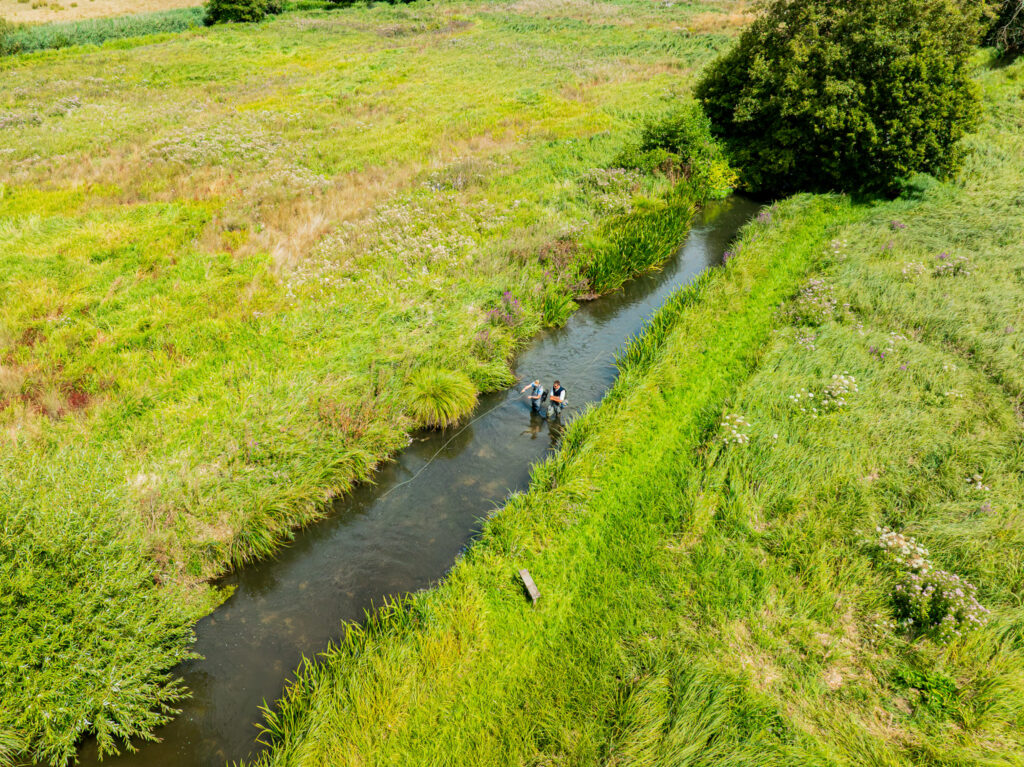
It took perhaps 5 or 6 attempts for us to adjust to the up-close-and-personal nature of the spot, knelt at the water’s edge with a 9ft 4# superfine arced over as he drew his bow, his leader pinched between thumb and forefinger. The stiffer tippet held its shape well enough once it landed, the fly neatly stuck in the seam rather than skating off into the faster water, and it wasn’t long before Freddie’s buggy little EHC caught the attention of our quarry. His tail quivered inquisitively as he broke away from his lay and began to follow his meal in time with the drift. Damon hit record. “Strike!”
Freddie’s line fell slack. The overhanging trees had forced him to strike upstream, effectively relieving the hook of its duties and plucking the fly quite positively in the only direction guaranteed not to catch hold. Heartbreak!
Sparing us no time to grieve, our quarry returned to his lay, quite undeterred. He refused to rise for a little while and it became clear he wasn’t going to fall for the elk hair caddis again, so we opted for something that could conceivably have been blown onto the water from the tree canopy above, a black beetle. Not all-together halfordian of us, I’ll concede, but nevertheless we soldiered on.
Some moments passed before Freddie could reposition his fly under the tree branches, by which time a second, even larger fish had begun to rise, sipping happily at the very back of the run where the alder leaves brushed the water. This time, with a beautifully precise roll into position, the fly plopped onto the water at the edge of the tree roots. A careful mend slowed everything down nicely and gave Freddie time to bring the rod tip across his body in anticipation of a sort of sideways, downstream strike. There was no missing this one. He rose with real conviction and scoffed our little beetle without a second glance.
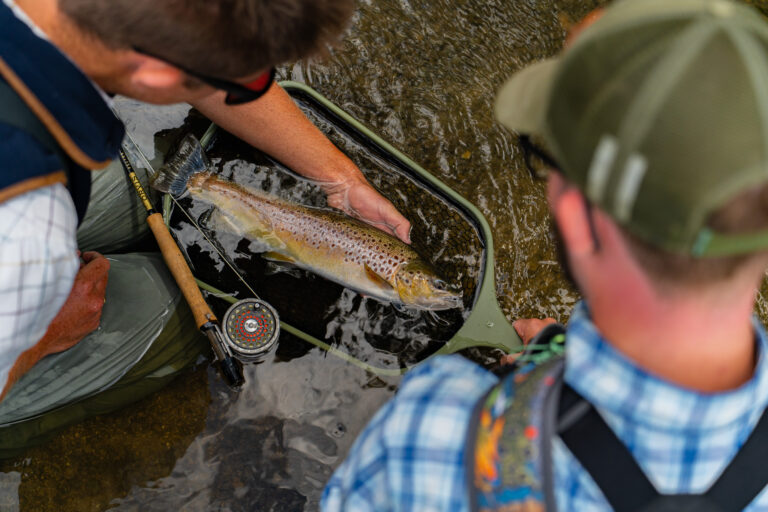
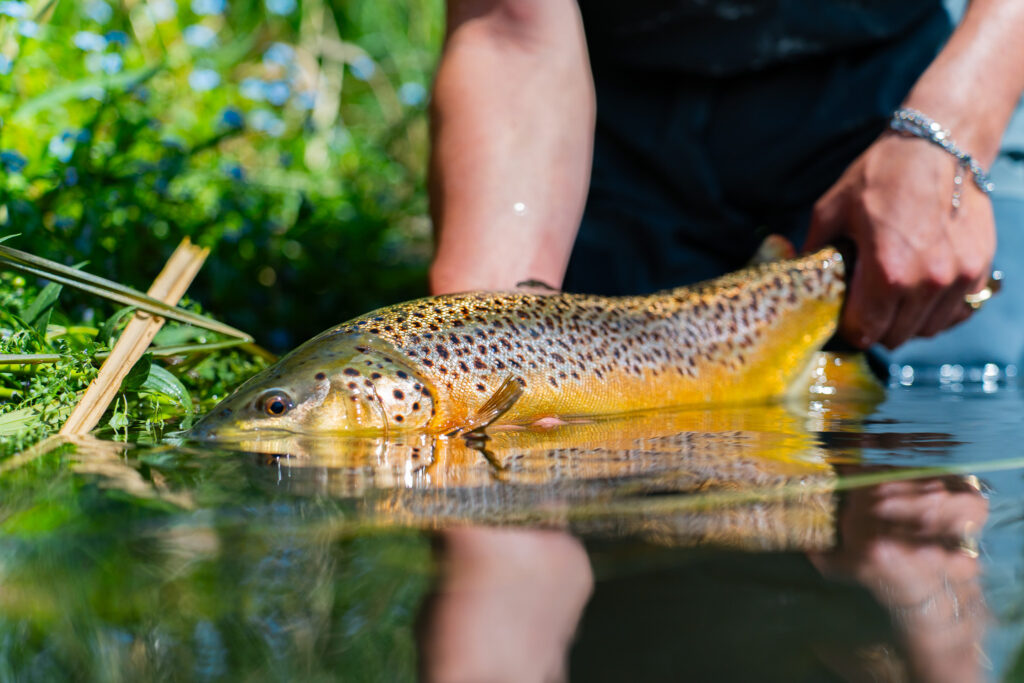
After a fraught battle on his knees, Freddie managed to coax the fish away from any danger and despite all the ribbon weeds snarling up around the water knot, we brought the fight to a swift and happy ending with a large Kennet brownie in the folds of the net. It was to be, by common agreement, the fish of the day, a heavy old brown with a huge head and tail, the kind of trout that reminds you why people fall in love with chalkstream fishing in the first place. There were high fives all-round and to our delight, Damon had caught the whole thing on film.
That first fish set the tone for the rest of the morning, and it cemented in our minds that the terrestrial approach was to the betterment of our chances. There is something about a beetle pattern on a day like this that trout simply cannot resist. Brown trout tend to be much more opportunistic by the end of the summer, as opposed to the preoccupated behavior we are so accustomed to during the high season. The menu of aquatic fly life on the chalkstreams is slimmer in August than in the bountiful months of April, May and June, so perhaps those big juicy terrestrial meals are just too good to pass up. On blustery days like this one, a large, heavy-displacement pattern must be that little bit easier to spot in broken water too. We could well imagine the wind stirring up the insects over the water meadows, whisking them high above the trees and dumping them onto the surface. Then there is the plop, where all finesse is thrown out the window in favour of that unglamourous presentation that so grabs a trout’s attention. It is rather an agricultural approach for an otherwise chocolate box chalkstream setting, but absolutely necessary given the conditions.
Breaking briefly for a celebratory lunch, we went on to visit the sweeping glides of the main river where by this time there was a considerable chop on the water. Not quite a Force 5, but white horses were forming, I’m sure of it. Fortunately for us, the main river at Benham Park can be split into two halves, one comprising wide-open water meadows, grassland and sparse trees, the other much more densely wooded with towering oak, beech and ash all around you. We opted for the latter and set foot downstream in search of forest and fairer winds.
Pausing at some wide open shallows, we noted the water clarity was in fact not the gin clear chalk water we are familiar with on the Hampshire Test or Itchen. Instead, the river carried a slight tinge of colour, a common theme on the River Kennet because it occasionally suffers a light algal bloom throughout the summer months, and well, it has been one mightily hot, dry summer! It never truly affects the fishing though and just as I was explaining this to Freddie, we spotted a confident bulge in the surface film as a fish rose to sip up his afternoon tea.
This fish took real patience. It required a long cast on Freddie’s behalf where, much to our frustration, the wind had taken a hold once again. Three separate patterns were refused outright, the fish clearly unimpressed with something about the fly choice or presentation. An Elk Hair Caddis, Goddard Sedge, and our trusty Black Beetle each drifted idly by as the trout continued to rise. The truth is this fish was probably sipping up a flurry of emergers, but we simply couldn’t present a small enough pattern to imitate it. We needed something bushy, leggy, buggy enough that it would break through the ripples, and sit proud for the duration of the drift. Cue, the daddy longlegs.
Whilst Freddie was positioned a little downstream, and couldn’t see anything, I had a better view of the fish in its lay. I had him adjust his position slightly, so that he had space for the backcast, and pointed out the spear of ribbon weed, towering out of the water and trembling in the current. His cast needed to be just to the left and maybe 3 feet upstream. The fish was just downstream, sitting in what was presumably a dead-spot behind a little hump in the gravel. Freddie threw a long over-head cast, landing the fly line perfectly, but our foam daddy got swept away in a gust, landing 3 feet behind the fish instead. Determined, he tried again, this time keeping the rod and line lower to the water, punching it under the wind and tweaking the fly line in his left hand to force the leader to unroll. The wind caught it at the last moment, and this time the fly landed with a bit of a thud, inches above the trout’s head. The fly was floating off, drifting over the back of the fish from head to tail, when quite suddenly he swung around and followed it. He caught up with it quickly and without hesitation, plucked his evening meal off the surface. “Strike!”
This time, Freddie struck expertly and the water erupted, the fish quickly storming downstream in a bid for deeper water. I joined him in the water to scoop up his prize, patting him on the back as I drew the net. Our efforts had finally paid off.
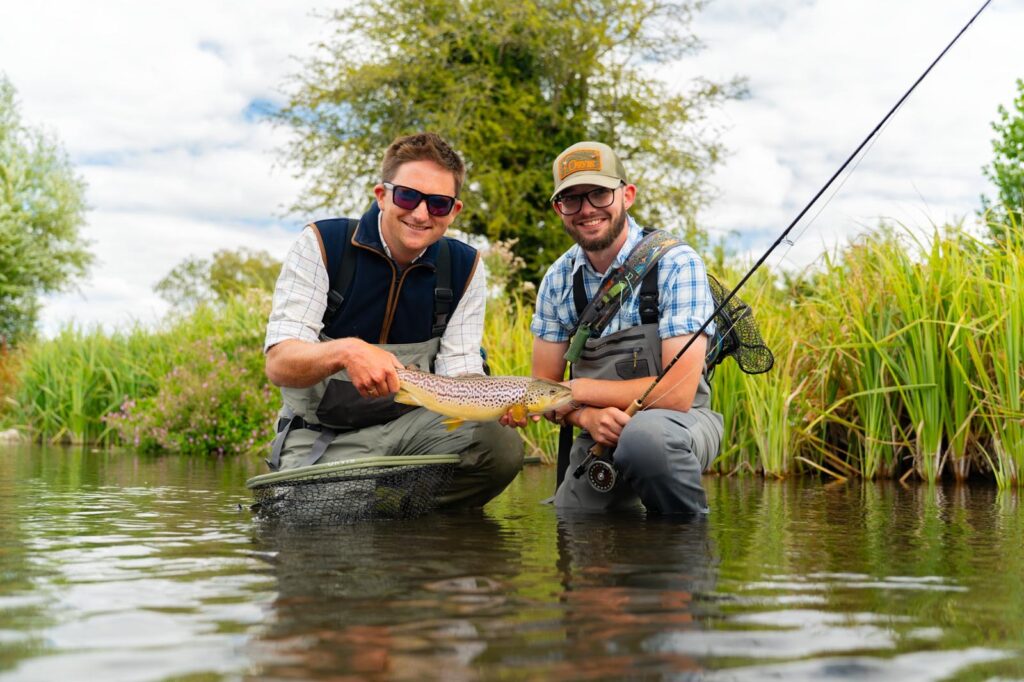
Days like this remind you why Benham Park is such a special place to guide. Much less busy than her Hampshire cousins, the Kennet is truly a Wilderness on the chalkstreams with vastly untapped fishing in the prettiest surroundings. I think the terrestrial patterns performed not just because they matched what was on the water, windblown and helpless, but because the conditions dictated what you are physically able to present. The trout made us work for it at times, and some considered changes to leaders, tippets and fly patterns were critical, but fishing in the company of two good friends made the day feel easy despite the tricky conditions.
We left Benham windburnt but thoroughly satisfied, with a memory card rammed full of footage to prove the whole thing had happened at all. Now, the pub!