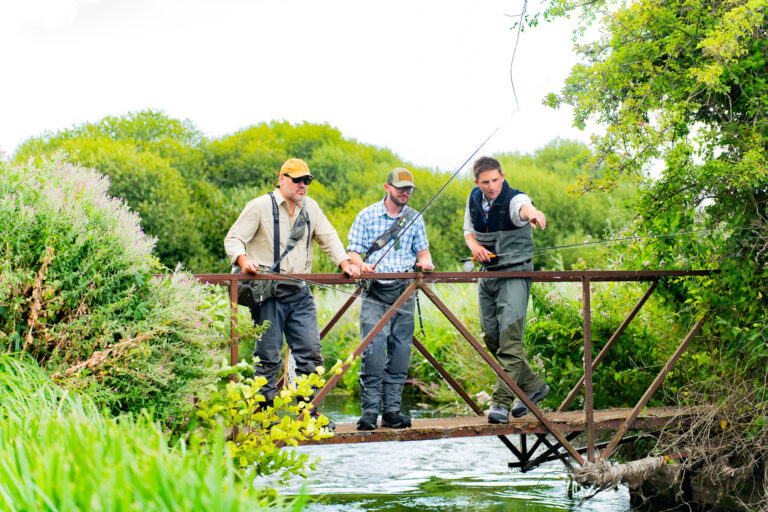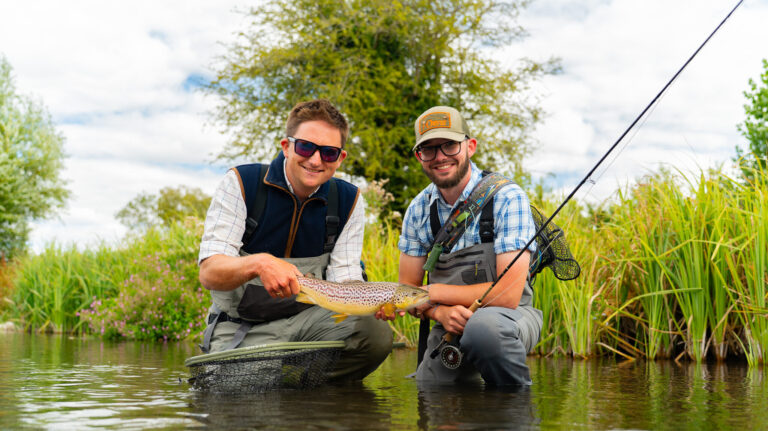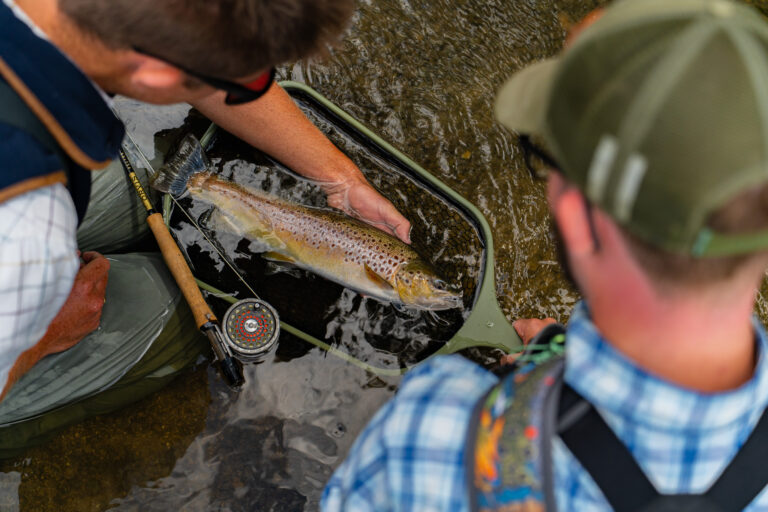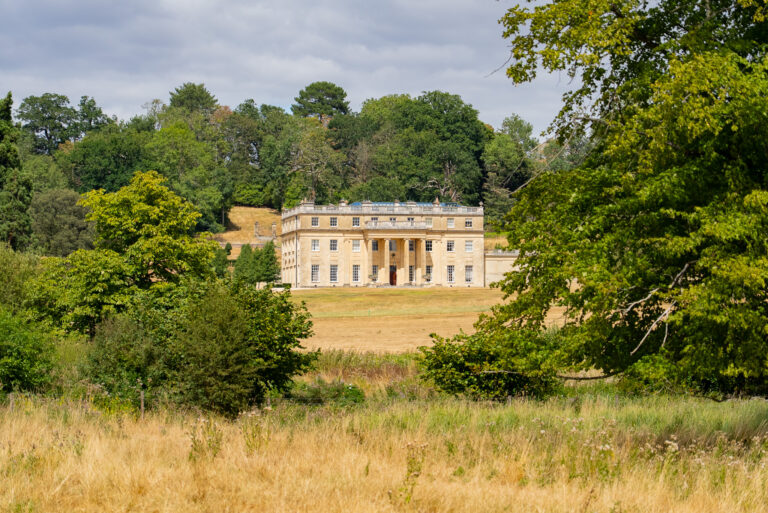

Hi there, Jamie here at the Wilde Trout Journal. Thank you very much for tuning in. This is episode three of the brand new podcast, and today I am on the River Test.
Better still, I’m at the Oakley Beat on the Mottisfont Estate, and I’m only feet away from perhaps one of the most famous fishing cabins anywhere in the world.
It is, of course, Halfords Hut, where in just a moment, I’ll be stepping inside to have a chat with none other than Neil Swift.
He’s the project officer at the Wessex Rivers Trust, who’s been charged with designing and delivering some of these great restoration projects across our southern York streams.
And today, I’m really looking forward to a conversation where I can try and understand what makes an ex-riverkeeper turned river restorationist tick.
So without further ado, I’m just waiting for him to drive down the track, and then I’m going to welcome him inside, and we’re going to get stuck in. Stay on board as long as you can, and we’ll see you at the end. Neil, welcome.
Thank you.
Maybe I should be welcoming you.
I think you probably should be. It’s lovely to be here. Describe the day for us.
It’s pretty overcast at the moment.
It is. It’s overcast, but it’s still, there’s no wind. It’s probably 13 or 14 degrees.
Yeah.
Maybe a little bit warmer.
It’s all looking rather lovely.
Just about warm enough to sit outside. We did talk about doing this inside. Where are we?
We’re at Halfords Hut, which is probably the most famous fishing cabin in the world. I think it’s fair to say.
I certainly think it is.
What do you think about that?
I think it is. As Jamie says, we’re outside Halfords Hut at the downstream extent of the Oakley Beats at Wottisfont Abbey. It is a rather lovely place.
It’s pretty special, isn’t it?
We’ve got the Oakley muddens here that are maintained by the National Trust, and we’re sat probably, I don’t know, 15 yards from the River Test.
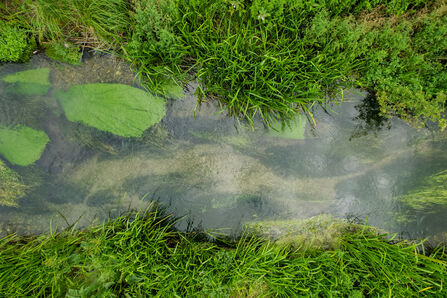
If that, we’re on the western carrier of the River Test. It’s slightly smaller than the main river, about 10 or 11 meters wide, relatively shallow and pacey at this point.
Yeah.
We can hear the burbling of water in the background, which is always rather lovely.
Yeah, it’s pretty special, isn’t it? I did the intro a little bit further up there.
I think it might be a bit loud because I stood right by that riffle there where I think you’ve removed a weir just up there, and it’s tumbling over what’s left of it quite loudly. So we might be able to pick that up on the mine.
Anyway, I thought we’d start by talking a little bit about your kind of affiliations with the Mottisfont Estate and the fishing here, because it goes way beyond just the work that you’ve done in recent years, doesn’t it?
2:55
River Keeper Journey
When did you first start here?
So the first time I set up the Mottisfont Estate would have been actually 15 years ago this year, as a student at Sparshopt College.
That ages you.
It does. Although I was actually in my mid-twenties when I went back to Sparshopt, it was my second degree.
So I originally actually got a degree in advertising and brand management, and soon discovered that city life and the ad industry was not going to be for me. I’ll spare you that long, tortuous story.
If you could.
But I, like I say, in my mid-twenties returned to education at Sparshopt College, and in the second year, at that point in time, everyone did a project here at Mottisfont, where you came and did some electrofishings, and then you looked at that data,
and made various assumptions about the habitats, and what fish you were finding, and the different size groups, and all sorts of things. And it just so happened that at that point, the National Trusts were looking for someone to look at all the data
that the Sparshopt groups had taken over the preceding years as a dissertation topic. Which I was asked by my tutor if I wanted to take that on, and I did. And that kind of got my toe in the door here.
And then by stroke of luck, the point that I was just about finishing my degree at Sparshopt, the River Keeping Jump came up. And I think it was advertised in kind of February of the year that we were, I was doing my final exams.
And I applied for it and was fortunate enough to get that job. And I started part-time whilst I was doing my exams and full-time the first day after my exams had finished.
So it was a bit of a fairytale story having gone back to education with the hope of doing something in and around the fishing world. I’m not sure I knew exactly what it was going to be when I went back.
And so are you a river keeper at this point?
Yes.
Fully fledged?
Well, I mean, only once I got the job.
No underkeeper experience because that’s the kind of the normal entry. Somebody’s pretty well got to pass away, as it is these days, for you to get a job on the river.
Yeah, very much so. I think it’s always a little bit different with the National Trust in that they’re not just looking for someone with practical experience. They’re looking for someone who’s also got the…
Is it kind of in line with the National Trust EFOS in terms of how they managed the river?
And for them, having someone with some background that’s a bit more academic in terms of the research that I’d done whilst I was here, understanding a bit about the fish populations at that time.
And also being a mad, keen fisherman who loves the sports, knows a lot about it. There’s not a huge number of people out there who fit into that category. I think I was relatively lucky to be that person at that time.
And yeah, like I say, started first day after finishing my exams.
And what time of year would that have been? So, I’m just trying to paint the picture of the first day.
Well, so I started part time, like I said, before exams finished. So, that would have been kind of March, April. I think my, I think if I remember rightly, like my first week full time was pretty much the first week of the fishing season.
So, April, May, that sort of time?
Yeah, I think it was mid to late April.
I think we used to start last week of April rather than the first week of May.
Okay, so things are growing, grass is growing, the reeds are growing, the fringes are growing.
Yes.
The river is probably brimming, but quite clear. That’s the general kind of, plenty of water around, perhaps some good fly life.
Bits and pieces, yeah, I think so. And it was very much like throwing straight into a season. We were at that time stocking, so there was fish to organize, there was mowing to do.
And when you say we, that was just you doing this, wasn’t it?
More or less.
Did you have somebody to help you?
Well, I mean, I definitely had some good oversight in the early days from the National Trust.
There’s a whole ranger team here that work on the estate as a whole. You’ve got Dylan, who leads the charge here, and who was also back in the day, had a stint as river keeper. So, there was plenty of people to help me along the way.
And some experience to draw on, maybe a little bit.
Yeah, exactly.
I think that was very valuable because, you know, river keeping on the River Test is something to get used to. It’s not the same as a lot of other places.
Well, it’s a full-time job, in my experience, at least. You’re working really seven days a week, even if you’re contracted for five. You never stop thinking about it.
You wake up in the morning and you think, right, I need to get the grass mown or the reeds cut, whatever it is, it’s a constant kind of, it’s just a never-ending cycle of life, I suppose.
Things growing, you know, and I suppose by April and May, things are starting to really grow quite quickly. So you probably felt like, I imagine, having to keep, would it have been four beats then?
It was four beats.
You probably felt like you had your hands full.
Absolutely. Yeah, I think I did. And I think the other thing definitely to notice is, you know, some help from National Trust volunteers.
I had, at that point, a wonderful volunteer group who came in twice a week. And I had a chap named John, who was my river volunteer, who worked with me every week for the seven years that I was keeper here. Amazing.
You know, still someone I consider a good friend to this day. It’s, yeah, so whilst I was the river keeper, I can’t pretend that I was constantly out on my own.
It’s a lonely life for some of us, Neil. You were so lucky. Well, so did you manage to befriend your upstream and downstream neighbours fairly quickly, or was that something that took a bit of time?
To some extent, to some extent.
Certainly downstream, at Kimbridge, Steve and Stuart there. Got to know them fairly well, because we were a customer of their fish farm as well. And at that point, Brian Parker upstream always communicated well on weed cuts and things like that.
So, yeah, and you know, as life goes on, you bump into other river keepers here and there and start to learn who else is in the same line of work.
So, just for people that maybe don’t know, you mentioned the weed cut.
10:21
Test River Management
It’s something that’s very unique to, not quite Hampshire, but nearly only in Hampshire, I suppose it’s fair to say. It’s sort of a, you know, where it happens on an almost industrial scale.
Can you just describe to the layman what the weed cut is beyond just cutting a bit of weed?
So it’s, essentially on these short streams, you get prolific growth of the different weeds that live in the river.
Primarily ranunculus, but also water parsnip, so brood or erector, there’s also watercress in the margins, and one or two others as well.
Star Wars.
Star Wars. In slower areas, you’re going to find ribbon weed. One of the jobs of the river keeper is to manage the amounts of weed that’s in the river.
You do that by hand with a scythe in most instances. In some of the deeper stretches where that’s not possible, there’s a weed-cutting boat that comes in that helps with that. And your job is to manage that level of weed.
And there’s three different weed-cut periods during the fishing season. So in June, July and August, you get, I think it’s ten days in June and then a week in July and August to get that done.
And it’s quite the operation, is it? Everybody sort of works together in the system. So for your kind of period here at Mottisfont, you would have been part of that system.
Absolutely.
Communicating with your upstream and downstream neighbours and just making the whole thing flow.
Yeah.
So what you’re talking about there is clear down. So at the end of which we’d cut, there’s two days worth of clearing the weed down.
And you’re basically waiting for a phone call from your upstream neighbour to say that they have pushed all the weed down through their reach.
And it’s with you now, at which point it’s your job to, as quickly as possible, get all the weeds from your beets, send it downstream, at which point you call your downstream neighbour and they take it from there.
And certainly on this part of the stretch, the River Test, it all ends up at the weed boom down at Great Bridge, where the environment agency haul it all out and compost it from what I understand.
And one of the funny things I need to mention about that is, I used to do a bit of work on the Diva, as you know. It’s just a tributary to the Upper Test.
And the weed that we cut there comes all the way down and eventually gets taken out, I don’t know how many miles that is downstream, but at the Great Bridge boom, just upstream of Romsey.
And it gets put on the back of a lorry and taken all the way back to where it’s come from, nearly, and spread on the fields all around.
You know what? I didn’t know that.
Did you not? I think that’s fantastic. So they use it as fertilizer.
Yeah. So all this is going on throughout summer months when the weeds growing really quickly. And it is an integral role of being a river keeper.
And for the period that you were a river keeper, it would have been something you maybe looked forward to for a while.
Oh, absolutely.
During it’s quite a busy period, isn’t it? And it can be quite stressful to get it all done in a week and all the allotted time period. And then you’ve got to clear down and sort of prepare for the next one.
And it happens, as you say, June, July and August.
What I was trying to get at really, by asking you that one, was you actually do have quite a well-rounded knowledge of what it means to be a river keeper, having been one yourself for a good number of years. Yes.
And worked across four different leaps, which although they’re part of the same estate, are quite different from one another. They have very different demands.
Yeah, absolutely.
You’ve got the main river, which is much wider. And you’ve got the Oakley here, which is different in its own right. You’ve got the Dunn, which is a different river entirely.
Perhaps you could tell us a little bit about the Dunn and how that differs from the Test.
So the Dunn is a tributary of the River Test.
Yeah.
Heads out towards Salisbury or comes from over towards Salisbury, is very different in character. People would argue back and forwards of whether it’s a true chalk stream or not.
It probably doesn’t receive quite as much water from its aquifers as the Test, for example, in terms of percentage. By virtue of the valley it runs through is much flashier than a typical chalk stream.
So it does feel a little spate-ier at times, where if you get a heavy dump of rain, the water level is going to come up very quickly, especially during the winter.
And it would be fair to say it carries quite a bit of colour with it when it does that as well.
It does.
It’s not your sort of typical gin clear chalk stream. Yeah.
So certainly during most of the summer, you’ll find it gin clear, same as the Test. But certainly early season and some extent later in the season as well. If you’ve had rain prior to fishing, you’ll find it’s got more colour in it.
It’s really interesting.
Yeah.
And so does that, it having a slightly different valley, maybe slightly a different substrate, I don’t know.
Do you think any of that plays into it having different fly life? Or is the fly life the same? How would you categorize that?
I can’t speak to the river as a whole.
But looking at Abbey to Mottisfont here, I’m not sure what it is, but it does have fantastic fly life. So it will have an epic Mayfly hatch. If you hit it on the right day.
Gun smoke drifting over the water.
Absolutely.
I think sky’s black with them.
The heaviest Mayfly hatch I’ve ever seen was on the River Dunn in my first year here, actually.
And that would have been 2013, 2014. And it was, yeah, absolutely. And actually it had been a very cold start to the year.
And that actually happened during June weed cut. Damn, it was remarkably late. I’ve never known it’d be so late since.
Generally the Mayfly hatch on the Dunn is very similar timing to Mayfly hatch on the rest of the, on the rest of the chalk streams in the test. Yeah. And it was actually late.
But what I’ve always noticed about the River Dunn here is the kind of post-Mayfly hatches. So blue-winged olives, sedge in that kind of June period where often things can be a little bit tough on the test.
The fish have been well fed over the preceding weeks on Mayfly. Fly life can be a little bit limited post-Mayfly. But the Dunn, certainly over here on the Mottisfont Estates, you can get some fantastic hatches in that kind of, just after Mayfly.
I’ve never known a Mayfly hatches as late as mid-June on any form of test, I don’t think.
No, and I can’t remember it ever being that late since.
Because what’s interesting, I’m sure you’ve noticed this, is that you can almost time the Mayfly hatches from east to west, in the south of England, at least.
You start on the Itchin, let’s say, or the Mion, and it’s usually quite early. It’s usually sort of the first two weeks of May. You start getting some really prolific Mayfly.
You come over to the test, and it’s usually, correct me if you think I’m wrong, but the sort of the middle two weeks in May to the last week in May, those sort of three weeks.
Then you go further west again and you end up on the Avon, and that can extend quite long into June. But to have a June Mayfly hatch on the Dunn sounds incredible, actually. It sounds ideal.
Like I say, it’s not something people should expect.
No.
It’s the one time I’ve known it to happen, but it was really quite remarkable.
Yeah.
But for a small little bit, it does enjoy terrific fly life, and that’s what I was trying to sort of poke you for. And so all of the beats here have pretty spectacular fly life in their various sort of fleeting bursts throughout the year.
And as you say, it’s not just all about the Mayfly. There’s terrific olive fly hatches later into June, and you get the sedge as well throughout the season.
So there’s quite a lot to be said for the period of the season that doesn’t include the Mayfly. The season’s so much longer than just those three, four weeks.
Absolutely. Yeah, I think you really have to take the opportunities when you get them in terms of fly life. Anywhere on the chalk streams, you can hit one of those wonderful days where there’s just epic hatches.
But there’ll always be something going on, even if it’s the odd fly life coming over, even if it’s actually there’s not a huge amount of fly hatching, but the fish are nymphing below the surface.
I think that’s always a valuable thing to be watching for, is watching whether fish are feeding subsurface. If they are, our job as fly fishermen is to mimic whatever they’re feeding on. Yeah.
Whilst Mr. Halford, who built the hut behind us, probably would turn in his grave.
I was hoping you’d tell this one.
Well, I think he would turn in his grave if he knew that nymphing was something we don’t discourage here on the estate. Like I say, our job as fly fishermen is to imitate what trout are feeding on. So we don’t restrict you to dry fly here.
Yeah.
And nymphing is perfectly acceptable.
And so maybe now is a good time to talk a little bit about Halford’s tenure here, all those many years ago.
20:13
Halfordʼs Hut Legacy
We’re obviously sat outside Halford’s hut, which is of course a very famous artifact in its own right.
But it might be nice to talk a little bit about maybe what Halford would have used the hut for and what he was actually doing when he was spending his time here.
So Frederick Halford was the fishing tenant here from 1905 to 1914. Okay. And he actually, whilst he didn’t die here, his fishing tenancy ended at his death in 1914.
And really, I think Mottisfont was kind of the place where he came to put it all together. You know, he’d actually written his most famous books before his time here. Yeah.
And so to my mind, it’s very much where he kind of came to put things into practice. And to have his place that he would, you know, his friends would come and fish here. And the hut’s very much a part of that.
It’s a better place for entertaining and resting and fly-tying.
And we saw a good photo last week when we were here. We did some redecorating, didn’t we? We gave it two coats of paint on the inside.
But whilst we were having a bit of a conversation, we were shown this lovely photograph of Halford. And I think one of his friends sat outside on the deck chairs.
Yes.
Do you remember that one?
Absolutely. It’s a wonderful photo. They both sat outside in the deck chair.
And I think it’s something we can, as fishermen, all relate to, not just the being in the water and the fishing, but everything that goes around it. The place, the relaxing in the sunshine, taking a little break.
So even Halford would have laid back and smelt the roses maybe.
Well, I think a lot of his philosophy around fly fishing, well, he wasn’t out there flogging the water. This was about fly fishing becoming a sport.
It was carried out in a specific way, where Halford was very much, he was all about dry fly, he was all about rising fish. Yeah. As I’m sure everyone who fishes the Chalks, Threadmills knows, fish aren’t always rising.
I can tell you that better than anyone.
What are you doing when fish aren’t rising?
If you’re not fishing an imp, you’re-
Drawing a blank, I think they call that.
Exactly. I think he was obviously as the gentry of the day. He had plenty of time on his hand.
It wasn’t as though he was just here for a day and going out, and trying his hardest to catch a fish all the time.
It’s about going out, finding out what was hatching, finding a fish that was rising, tying a fly, and then using that fly to hopefully catch the fish first cast.
And there was a story, actually, I think you told me a little while back, about how his river keeper would have gone off and tried to catch a mayfly done as it flew off.
Absolutely. I can’t speak to how much of this is legend and how much of it is reality.
The legend is that he would send his river keeper out onto the beat to catch in his hands, whatever was hatching, it could be a mayfly done, it could be a sedge sitting in the reeds, it could be an olive to catch it.
Bring it back to him in the hut so that he could tie one of his fly patterns to imitate whatever it was. And then when the evening rise came, go out and catch a salve.
I think whether that’s true or not, that’s a fantastic little tale of old, isn’t it?
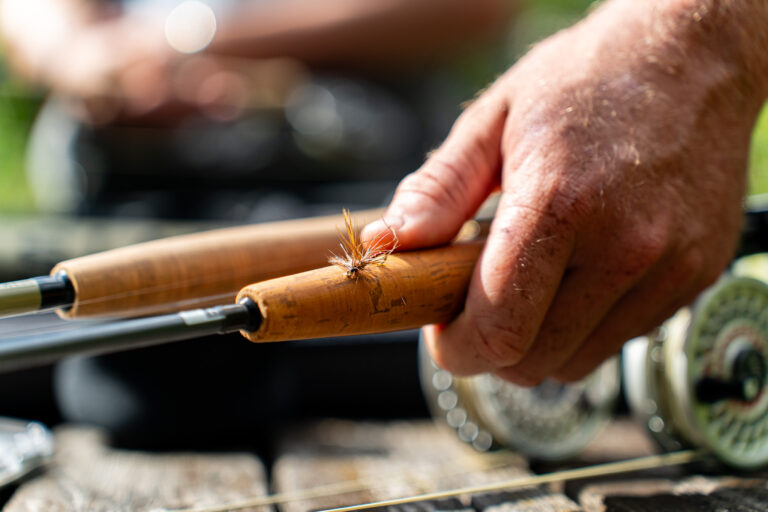
And we’re going to that end, we’re going to have our own little fly tying equipment set up in the hut so that if anybody chooses to, they’re very welcome to try and do the same, go off and maybe catch their own fly and bring it back to study it and
Absolutely.
And if you do happen to fish here and you catch, you tie a fly in the hut and go and catch a fish, please do let us know about it. That would be a wonderful thing to know that someone’s done.
Yeah, absolutely. I hope that people do do that because there’s nothing more exhilarating, I don’t think, than tying your own fly and then going out and tricking that very wily trout into actually taking it.
I mean, there’s something in that, isn’t there? There’s nothing more primitive, I don’t think, than to be able to do that and then to go home and say, you’ve done it and tell everyone about it.
So we’re looking forward to seeing if anybody will actually take us up on that offer and go off and take on the health of the challenge as it were.
Absolutely.
Let’s see if we can make that a thing. So I wanted to kind of reel back a little bit because we skipped past, just wanted to touch a little bit more on the other kind of roles of a river keeper. We touched on the weed cutting.
What else was in, sort of within your remit on the estate that you had to sort of take responsibility for?
So in terms of practical things, you spend a lot of time sat on a mower.
I know a few people like that, I can tell you.
So the paths need mowing most weeks during the summer. Okay. And, you know, it’s probably one of the bits of…
Was that a fulfilling part of the role?
You know what?
Absolutely. There is nothing quite like being up early in the morning, sat on the mower, maybe with the headphones on, listening to a podcast or perhaps some nice music, rolling around on the mower, no one else is around, everywhere looks beautiful.
It was a really nice thing to be doing.
Did you ever get it stuck?
Oh, yeah.
Because I’ve got mowers stuck everywhere, there’ll be people listening to this now, I know, that know that I can get a mower stuck pretty well. So tell us a story. You must have got a lot of stuff.
To be honest, I don’t have any like, absolutely.
Hang on, you’re not a river keeper if you’ve never got a mower in the river, Neil.
You know what?
In that case, I’m not a river keeper.
Because whilst I’ve had the mower stuck, well, I’d say several times, probably four or five times, always at the start of the season, when the ground is a bit soft, and you’re not quite sure where it’s going to be soft enough to mow and where it’s
I’ve popped up.
Yeah, I know.
I’ve had a few of those, but I have escaped the economy of getting the mower into the river.
You’ve done pretty well. I can think of a few people who have done that over the years. Actually, it’s reminded me, just upstream on the Dunn, get two beats up, there was that chap who left his hand break off and rolled his car in.
Do you remember that?
I do remember that.
I was there a few years ago.
Yeah, I was very close to going. I was actually there doing a water vault survey.
Of all things.
Of all things that day.
Water vaults probably got a bit of a shock.
They must have done. We spent the day rifling through the undergrowth looking for signs of water vaults.
Right.
And came back downstream. And to my absolute shock, there was a car, the rear of which was overhanging the river.
And I can quite believe it because there’s, it’s slightly difficult to describe, but there’s a bank that probably goes up three, two, three meters. Right. About 45 degrees to a little car park area of the property.
But there is no imaginable way that you should be in that process.
Yeah.
And it turned out the guy whose car it was, was actually a delivery driver, who had been delivering a parcel to the property.
Yeah.
And I remember asking him, like, what on earth happened? And he had this protracted story about the automatic gates and something to do with the fact that he had to reverse because of the automatic gates.
And but still like, it’s like 40 yards from the gate. It is. To this day, I have no idea.
Unbelievable. But it’s…
It’s very fine. I remember seeing the photo. It was probably a foot, wasn’t it, from going into the water?
Oh, yeah.
It was…
Pivoting on a wall.
It was. Unbelievable. It was.
It was, yeah, quite remarkable.
Well, we could make a book about stories like that, I think, between the two of us and the rest of the Riverkeepers on the Testinich. I’m sure there’s loads of stories like that going around.
But I really wanted to come back again to the water voles and you doing those surveys. And there’s so much more to river keeping, but also maintaining rivers, restoring rivers. There’s so much more to the chalk streams than just the fishing.
And the water voles surveys that you do is one example of that. Can you tell me where you think this sort of obsession with the outdoors and the wildlife and nature and fishing, where did that kind of come from?
Was there something in your childhood that made you think, I need to spend my life outside? Because I think it’s fair to say you’ve spent a good number of your years in the outdoors.
So I can’t remember if it was my third or fourth birthday, but I received from a great uncle, great uncle Sid, gave me a Fisher Price fishing rod, toy fishing rod.
Is that the one you used yesterday?
Of course, it’s still my main rod. But essentially, it was a plastic fishing rod with a little plastic closed face reel on it. Right.
And that being closed face, that being the most important part of a toy fishing rod.
Exactly, in that you can’t just strip all the line off as a child.
And it came with this little plastic orange goldfish that you tied to the end. And you could cast it like a proper rod.
So you’ve caught one before you’ve cast it.
Absolutely.
That sounds like your style.
Absolutely. And I can remember taking this rod to the local pond near where I grew up in South London. And for whatever reason, from that moment fishing was what I wanted to do.
And I can remember casting this little orange fish into the water there. I can then remember using that rod on holiday in France to catch sprouts off the pier. Yeah.
Like, annoying all the old French men who got their bags of rubby-dubby off the wall of the pier.
Yeah.
And me just inching closer and closer and closer to crying cats, the sprouts, and eventually getting all tangled up with them. And I think them very graciously untangling me and sending me back to my dad.
Yeah. That was a visit the fishmongers on the way home.
Well, we used to catch plenty of little sprouts. Yeah, like whitebait almost.
Did you do the whole mackereling thing as well?
Oh, yeah. Not so much there, but then slightly later in life when we go on holiday, where it was down to Devon or after Scotland, there’d be mackerel and pollock.
Yeah.
And when we weren’t on holiday, slowly got into course fishing.
Okay.
So my dad had fished as a boy, but had not done any since his early 20s. So me getting infused about it dragged him back into it. And then, so we did lots of course fishing.
And then there was a point in my dad’s life where he was traveling a bit for work. So he’d be away nights. And he’s not a kind of go to the pub or the hotel bar in the evening kind of person.
And he realized that if he took up fly fishing, that that was something really easy that he could pop out and do in the evening. So he was never going to take all his course fishing kits away within one business.
But actually a bag and a rod full of fly fishing stuff was super easy. But then, you know, he could find the, don’t you have a still waters, but he could find the nearest still water to the hotel, finish work, pop out and go fishing.
And I’ve got various memories of him bringing back, bringing back trout from his business trips. And so obviously knowing that he was doing that, me at 10, 11 years old, I want to do that too. Yeah.
So we got some fly fishing kit for me as well.
And have you always fly fish since then?
On and off, on and off.
So fly fishing was always more of an occasional thing in that it would be something where, you know, we would do it more occasionally, maybe if we were away, maybe, you know, those kinds of times where my dad and I wanted to go fishing, but we only
had an evening to spend and you could pop out. There was a couple of local, localish still waters that we could go to.
We had the occasional day that we’d go out to, down to Beulwater and like blank there, because neither of us had any idea how to fish a reservoir.
It’s quite a different animal, isn’t it?
It is, especially because like we’d never get a boat out, like we’d always be on the bank.
Fishing this vast expanse of water.
Exactly.
And all we’re used to is the one acre farm pond.
That’s exactly it. So fly fishing was kind of always the smaller part of my fishing life. In my teens, I got very into match fishing in the course fishing world.
So I fished for my local club as a teenager. And I think that was something that as soon as I turned 18, it all got too serious for me.
And where are you at this stage in your life, in the country? Because you didn’t have you down as a Londoner to start with.
I grew up in Bromley, in South London. And if you speak to someone from London about Bromley, they’ll say, oh, you mean Bromley in Kent? And you’re like, yeah, I mean Bromley in Kent.
Because it’s technically Kent, but you’re within zone five of like the travel in London.
Is it? Oh, it’s definitely London then?
Yeah, I see it as kind of South London, but it’s very much the suburbs. And I was very lucky where I grew up. We’re right on the edge.
So, you know, as a kid growing up, it was great because there was, you know, within half an hour, you can be in central London. So as a teenager going out and going to gigs and things like that.
But at the same time, 10 minutes the other way, you’re in open countryside.
Yeah. Yeah.
And it was a it was a nice a nice place to be.
And then later it later into your sort of teenage years when you were going out doing some more of the match fishing stuff. So that was still in that area?
Yeah. No, no. So I that was all very much in the kind of down into Kent.
Right.
So the Tunbridge area, we were a member of members of Tunbridge and District Angling Club.
Yeah. And we that was who I fished with. Had a great at that point, a great junior section run by a guy called Brian Kvirtz, who is definitely one of those people you look back and you’d love to tell them what you’re doing now.
Yeah.
Because you think, they’d be really chuffed to see that fishing has become such an integral part of my life.
Yeah. Which, it was great times, like traveling each weekend around to a different venue to fish a mat, short ago to go fishing with my dad. Sure.
Really.
It’s the thing you look forward to at the end of a week.
Oh, absolutely. Yeah.
It was for me too.
Definitely. Yeah. Yeah.
Very much so.
Yeah. I never did the mat fishing stuff.
I went straight from sea fishing, which I used to do with my old man on the river, fishing for bass and flounder in the estuary, and then went from there straight into fly fishing, and I’ve dipped in and out of fishing by the float, which would be
similar to how we’ve fished, I imagine. We used to do that on the river, and we used to flat shower floats out of goose quills and fill them with polystyrene balls. They were super buoyant, but very, very light.
And that way, you could get a really delicate indication if a grayling, which were very finicky, if a grayling took your little white maggot at the end of the line. So we used to do things like that.
But it wasn’t until I was a little bit older, I was probably 14 when I picked up live fishing. So it sounds like you were probably quite a bit ahead of me.
Probably a little bit younger. I think we’re thinking 10 or 11 at that kind of age. And yeah, most of our fishing, like I say, would have been local still waters.
It wasn’t until, like I mentioned earlier, I moved down to Hampshire to study at the far shelf that I ever cast a fly on a river.
So remind me, what year was it that you started here at Mottisfont?
It would have been 2014, early 2014.
My goodness.
It was early 2013. One of the two.
Well, I don’t want to put 13 years on you, Neil, but it’s 2026. So when did you finish here at Mottisfont as the river keeper?
2020. That must have been 2020.
What was the turning point? This is what I’m really interested in. You were there for eight years?
Yeah.
I think there was numerous reasons. I think part of it was that there’s very little… In river keeping in general, you’re either a river keeper or an underkeeper.
You might be a head keeper or an underkeeper. Yeah. And because here with the National Trust, the river keeper was very much kind of the equivalent of a ranger role, but very specialized.
Any move up takes you away from the river. And whilst I love the countryside in general, nothing against woodlands, nothing against other parts of the countryside, you know, the reason I’m here is because of fishing and rivers and fish. Yeah.
So moving up within the National Trust was not something that was ever really on the cards for me. And at that point, you know, my then girlfriend and now wife, we’re starting to look at buying a property together, thinking about having a family.
And I realized I needed to earn more money than I was. And there was also a need for progression. I think it takes a very special kind of person to be one of these river keepers who’s on the same estate for 30 years.
I think it’s wonderful that people do.
Isn’t it fascinating?
I think it’s incredible.
There are boys on the river today that have been doing it for 60, 70 years, maybe longer.
Yeah. I think it takes a very particular type of person. I’m not really sure what that particular type of person is.
I think to dedicate your life or your working career to one piece of river or one estate of river is a really wonderful thing to do. But it wasn’t going to be for me.
I think having done very similar things for seven years at that point, I wouldn’t say I was bored of it, but I needed something new.
You’ve got the job at the Wessex Rivers Trust. Can you tell me a little bit about what the Wessex Rivers Trust actually is? What’s their remit?
What do they do?
Absolutely. Wessex Rivers Trust, I think it’s probably best known and certainly within the probably your listenership in the fishing world, best known for the river restoration work we do. But there’s other things as well.
I think it’s great to give some airtime to.
We have a wonderful education department who go out and deliver education sessions for children, mostly primary school children, but they’re also branching out now into secondary school and further education.
But running amazing classroom sessions and assemblies, or actual on the river bank, river dipping sessions. Kids infused about the natural environment and rivers and how to look after them and protect them as well.
And is that sort of doing the old kick sampling stuff, getting in the river with a pair of wellies on and throwing an avalanche into a net? Yeah. They always love that, don’t they?
I mean, certainly in my experience as a guide who has done a little bit of the tuition stuff, teaching some of the younger generation, the bare essentials. We cover a little bit about chalk stream entomology.
And that is the one thing that will hook them above all else. Way before you ever show them how to cast or show them how to hook and land a fish. It’s all about the insect life.
And you can kill a couple of hours quite easily, just letting them root around in a white tray after the maze by nymphs and the crayfish and things. So I know that that is a really brilliant tool.
So the Wessex Rivers Trust are going out to all of these schools and teaching the younger generation, presumably teaching them all about chalk stream fly life and ecology and just the wider environment or?
Absolutely. Yeah, so essentially a lot of the time the age groups that they’re teaching the younger children, classroom and assembly kind of sessions are essentially all about what is a river.
So the rivers goes from the headwaters down to the sea and everything in between and really taking them through that whole story of the river from, it’s very source right down to the beach where they’ve probably been.
Yeah, it’s a really wonderful thing they do.
I think important to note in this that a large part of the reason that we’re doing the fishing at Mottisfont is all about providing some funding for our education department to bring children to Mottisfont to learn about the rivers.
All of the profit essentially from the fishing, and that’s where it goes.
Yeah, and it’s such a worthy cause as well. I mean, teaching the younger generation to have a much more intimate knowledge and understanding of nature and the environment.
It’s going to be one of the most important things we can do and instill in particularly the younger generation. And so it’s definitely great work. There’s no question about that.
And so we’ve got the education department, that’s one sector of the Wessex Rivers Trust. The wider trust itself is actually set up as a charity, isn’t it? Yes.
And so there’s lots of other things going on. But in terms of the work that you’re involved with now, I imagine that there’s actually quite a large part of your role that involves being able to talk to people.
Because I know from experience, a lot of your work seems to be running around trying to make friends with as many of the different stakeholders as possible.
Being able to communicate, I imagine, with the riparian owners, the river keepers, whoever it is, the various stakeholders in the river and the catchment. It must be quite important to be able to communicate on all those different levels.
I think so. Yeah. I think you’ve got to be able to communicate, but with, like you say, a wide range of different stakeholders.
Because one day you might be talking to a river keeper, the next day you’re talking to a landowner, and landowners come in all shapes and sizes from people that own a tiny stretch at the bottom of their garden, right through to people who own huge
estates with miles of river. And then there’s farmers who have farmland all around the river. You’ve got to be able to communicate with them to some extent.
And then you’ve also got to be able to communicate with statutory bodies, so the Environment Agency in Natural England. You’ve got to be able to communicate with contractors who you’re working with.
You know, it’s a job that does involve, you know, communication with that broad range of people that go into making these things happen.
Sure.
And so a lot of that is actually being able to talk about the type of work that you’re trying to do and to sort of cut a balance, whatever that looks like, in terms of optimizing the kind of the habitat for the chalk stream ecology in the wider
environment, but also kind of meeting the needs of the various stakeholders. So I’m just intrigued in terms of the sort of the type of work you’re doing.
It can look from the outside eye, at least initially, quite a sort of invasive procedure, one of these restoration projects. And I think you used the phrase earlier, you’ve got to crack a few eggs to make an omelet.
Can you tell me a bit about what I might get to see when one of these restoration projects is going on?
Absolutely.
46:44
Restoration Principles
It’s actually one of the things my… In fact, there’s two relevant things on that, that Mike, our Director for Operations, often says. One, he says that the projects we do are essentially a violent act.
You’re coming in and you’re often undoing, you know, things that were done centuries ago, or maybe things that have been done more recently, but you’re coming in and undoing them, whether it’s removal of a weir, whether it’s, you know, re-meandering,
whether it’s putting trees into the river, you know, it’s a kind of sudden and violent act, you know, carried out with excavators and chainsaws. And, you know, whilst they’re all meticulously planned, it is, and, you know, there’ll be mud everywhere,
because we always have to work in, you know, after the end of the fishing season, so in October and November. So you can guarantee, as soon as we have excavators on the ground, the heavens will open, and, you know, what was a lovely green bank will
turn muddy. But I think the, you know, the thing to always remember is how quickly nature repairs itself.
And whilst you could come at the end of a project and, you know, be quite surprised by the mud that you see before you and what looks like, you know, a bit of carnage, actually how quickly the next season, you know, the green will return.
And it’s all the better for the work that you’ve done. And the other thing that came to mind when you were saying that was, yeah, another one of Mike’s sayings, which is when you’re thinking about designing a project is, what would a storm do?
And this is particularly relevant to, you know, putting wood into the river. Because essentially that’s the natural process that we’re replicating is, you know, a storm coming through and blowing a load of trees down and going into the river.
And that kind of, that level of chaos, you know, that a storm might create. And then of course, you know, this again comes back to what you were saying about finding that balance for the stakeholders.
You know, when it goes, you know, you’re thinking about, well, what would a storm do?
But actually, how do we then fit that into that kind of idea, into something that still works, whether it be as a fishery, whether it be as a river with farmland next to it, and what we can do in that way?
Sure, sure. So I’m just thinking for any listeners that maybe don’t have any knowledge of what these types of things look like, this is quite a departure from your river keeping days, isn’t it?
Where we’re talking about moan banks, cut fringes, river keeping is often the process of making the river neat and tidy and accessible for all the various reasons, not just for fly fishing.
But just tell me what it is that makes one of these rivers come across your desk and you think, well, this probably needs some work.
What is it about a chalk stream, a beach or a stretch of river that you look at and think, actually, this is something we could improve, this is something we could do better?
Because the chalk streams have been maintained, as you know, and manipulated by humans for many hundreds of years, going back as far as the Romans and everything in between for water mills and flooding the water meadows, irrigation, transport, trade.
The list goes on. What is it when you look at a chalk stream that tells you actually we could maybe optimize this in some way for the benefit of Wilde Trout habitat?
Yeah. Essentially, a lot of the things that have been done historically to the rivers, like you say, for milling, for water meadows, etc. The changes that have been made essentially denude the river of natural processes.
For example, if you put a weir in, then you’re homogenizing the flow upstream, you’re interrupting the natural transport of sediments and light gravels downstream, where channels have been straightened.
Again, you’re homogenizing the way that the river moves, so you haven’t got meanders with the variety of flows and flow speeds that you get.
People may know, but on the outside of a meander, you’ve got a faster flow, so you’re likely to have gravels that are scoured clean.
On the inside of the bend, you’ve got the slower flow where silt would deposit, and then reeds would grow up and give you these lovely marginal fringes.
So a lot of the time where humans have intervened in the past, these are the kind of results you get, homogenized flows. Often there’s areas on the River Test specifically that have been dredged for gravel.
When you remove the gravel, you make it slower and deeper and more uniform. So a lot of our projects are around in some way reintroducing those natural processes. So that kind of happens in two ways.
Sometimes, the Oakley Beat, where we’ve been sat today, is a great example. That’s a channel of the river that was essentially built as a milllet for the abbey many hundreds and hundreds of years ago. It’s not a natural channel.
It’s perched away on the western edge of the floodplain. Your first question is always going to be, well, can we put this river back where it’s supposed to be? And in that instance, and quite a lot of instances, the answer is no.
There’s lots of infrastructure, roads, railways, all sorts of things that mean that rivers can’t be put back where maybe they should have been or would have been originally. And at that point, we have to look within the channel that we’ve got.
So what can we do within this existing channel to optimise that habitat, to make it more productive, not just the trout, but everything that lives in and around the river?
Sure. I mean, we’re going to go and have a wander off upstream shortly, and hopefully I’m going to pick your brains on some of the things you’ve done here at the Mottisfont Estate. But can you give me an idea of how long a project like this takes?
I mean, there’s obviously quite a lot of planning in the making before you even break ground on the river, presumably.
Yeah. So it really depends on the complexity of the project. So a project like the one on the Okee Beat here at Mottisfont actually was relatively quick.
The National Trust came to us in, I think it was March 2023, and we managed to get that project delivered in October 2023.
Okay. So quite a quick turnaround.
However, that’s probably more the exception than the rule. So there’s a long process that you alluded to there, which involves some degree of planning, and that depends very much on what you’re looking to do.
So for example, with a project like Mottisfont, you have to or we had to take lots of measurements of the river, so cross-sections, long sections to look at the gradient, to look at the banks, see what kind of channel we’re playing with.
So there’s quite a bit of science involved in this, isn’t there?
You’ve talked to me about this before, about using various technologies, and I think we touched on LIDAR in a conversation a while back, and you were showing me one of these maps you can use to kind of work out where the historic channels would have
been. And I think that was your answer to a question that I posed, which was, well, what are you actually returning the river to?
And I think most people could quite reasonably ask, well, you know, you’re restoring a river, but what are we restoring it to?
Definitely. So LIDAR, which you were just talking about, is essentially an image, type of imagery that shows you an aerial view of land. It could be rivers, it could be mountains, it could be whatever you’re looking at.
And essentially, in the same way, if you imagine a thermal heat map, which I think probably most people are kind of familiar with, it looks a bit like that, but the different colors denote different heights of land.
So, or different elevations of land.
And it’s fascinating, isn’t it? Because you can see, as you’re looking at the sort of the river catchment, you can actually see all of the old, what would have been presumably irrigation dikes and various extant channels that no longer exist today.
And you wouldn’t know they were there if you were just in the field looking.
You can, yeah. You can see a lot of the time in specifically the Chalkstream catchments, the Test, the Avon, and over on the Itchin as well, particularly, there’s a lot of old water meadow features. And a lot of the time, that’s all you can see.
You can’t see where these original river channels are. But occasionally, you can. And you can see where a channel has been filled in or allowed to fill in over time after it’s been rerouted elsewhere.
And in those instances, sometimes, there is the opportunity to reinstate it to its natural cause. And I think that’s, it’s, I always find the, you’re talking about, you know, what, what are we restoring rivers to?
And I think I probably wouldn’t call a lot of what we do river restoration necessarily. I think it’s one of those, those terms that people get very hung up on in terms of, you know, what, what are you taking it back to?
What do you want to restore it to? And there’s, in a lot of instances, and I think, you know, the Oakley-Veaton, other projects like it are a great example of where we’re not, we’re not restoring the river really at all. We are improving the habitat.
You know, we are enhancing the habitat or optimizing the habitat in, in whatever way you want to say. And there’s an, there’s an extent to which I think, you know, we don’t really need to worry about what the terminology for it is. Is it restoration?
Is it habitat improvement? So long as we’re improving these rivers, that’s, that’s what matters. But I totally understand.
Sorry, I was going to say, and that’s exactly what you’ve done here at Mottisfont, isn’t it?
You’ve taken the bit of river you’ve got to work with, you know, you’ve accepted that actually, there’s no way we could return this to what it looked like 500, a thousand years ago, it’s just not possible.
But actually, what we can do is optimize the habitat in terms of the broader ecology, but you know, the birds, the wildlife, the trout and the various other species of fish.
And I’m just interested, one of the big questions that I know that many of the listeners will have is, where does fishing fall into this? Because there’s no getting away from it.
Fly fishing has a sort of a massive stake in the local economy, particularly on the River Test.
It’s quite unique in that sense that Hampshire, with the Test and the Itchin and the Avon, has this kind of history and heritage and culture that revolves around fly fishing. It’s world famous for chalk stream fly fishing.
When somebody like the Wessex Rivers Trust comes along and says, we’d really like to restore your river, one of the first questions that will no doubt get bounced back at you is, okay, well, where does fly fishing fit in with all of this?
Let’s say we’ve just restored this beach at Oakley. What are you actually doing to ensure that fly fishing can still play a part in a river like this?
I know from first-hand experience, we’ve done project together on the River Deva, and I thought you were quite professional in the way you went about ensuring that we had these angler accessible berms in place.
58:53
Stakeholder Balance
I wondered if you could expand on the different ways that you can incorporate these things to ensure that the various stakeholders, be they fly fishing, the landowners, whatever it is, the different uses of the river, that all of these things are
Yeah, absolutely.
I think you mentioned the Oakley project there, and I think that’s probably literally the projects we’ve done at Mottisfont, the only projects I’ve worked on in the last six years, is where fishing hasn’t really been the driver or a major driver
behind any of the solutions that we’ve put in place. So, you know, that was one where the National Trust came to us and they said, you know, we want to do a project here.
And I said, okay, so, you know, to what extent are we thinking about fishing in this? And they said, you’re thinking about that 0% on this project. You know, we want to make this all about habitat.
And I said, okay, cool, let’s do that.
And that must have been like a first for you, no?
It was literally a first for me. Wow. So, every other project that we work on, on the River Test, has been on stretches of river that are fished.
And obviously, the Oakley is fished as well. But where landowners have to take the commercial viability of their fishery very seriously, you know, they have rods.
Many of these fisheries on the test have rods who have been fishing there for literally a lifetime. You know, they’ve been coming to fish there for 20 years. They want to be able to continue to come and fish there.
They want to continue to run their businesses successfully in terms of the fisheries. And so, any improvement of the river from an ecological point of view has to take fishing into account.
And I think it’s probably important to point out that on, you know, in the Habitats team, whilst not everyone’s a fisherman, a fair percentage of us are fishermen at heart. You know, we spent some time earlier talking about my history with fishing.
So, we’re people that love fishing, and we understand, you know, the importance of fishing to the stakeholders that we deal with. We talked specifically about some, you know, angler accessible berms.
And that’s simply what we would, you know, when we’re reshaping a river to give it more sinuosity, to give it diversity of flow, that kind of just refers to the fact that we do that in a way that’s accessible to anglers.
So, a lot of, you know, almost all these bits of the River Test have paths along the banks that fishermen can walk along.
And these angler accessible berms are essentially, you know, either gravel causeways or gravel built all the way back to the bank, depending on whether there’s water voles there or not, we need to avoid.
That, you know, maintain a path along the bank that can be walked during the fishing season by fishermen, but give the river that sinuosity that they’re looking for.
So, I think, you know, the project that you mentioned up on the Diva, you know, we were able to do that on one bank where we’ve got path and then on the other bank where there’s no access for fishing, we were able to use willow.
So, you know, felling willow trees and hinging willow trees into the river in order to, you know, create that meander from the other side using, again, using natural materials.
And in that instance, we were able, from memory, we were able to go a bit wilder than maybe you would elsewhere on the river because of the nature of the fishing there. It was already quite a narrow bit of river, as you say.
One side of it was, had been completely let go to the wild, hadn’t it? And so it was quite overgrown. There was plenty of trees to use for the various different works that you were doing.
And so the point I was sort of digging for there is that actually, contrary to maybe what is popular belief, there are ways that restoration projects like yours, you know, can and do take into consideration the many requirements and complicated
requirements of all the various stakeholders, be they fishing or whatever it is. And you do take quite a lot of care over that part of the project as well. And I can talk about that firsthand.
So I thought maybe now is a good time as any to have a break and then take a walk up the river. And maybe we can talk about some of the works that you’ve been doing here on the Oakley bit.
Sounds great. Let’s do that.
Let’s do it. So, Neil, we’ve come a little way upstream from where we were just sat down at the side of the Halford Hut there. And already we’ve spotted a couple of fish moving over the sort of over the shallows here.
We just seem quite large grailing.
We have.
So tell me about this little pool that we’re looking at. What would this have looked like five years ago?
So this is actually the spot we were just talking about where the National Trust initially asked me to have a look at, which was the banks on the left hand bank were formed entirely of concrete sandbags and about half of the right hand bank as well.
And the problem you’ve got with something like concrete sandbags or any type of revetment really is that it gives you a very sheer steep margin. And what you get there is it really limits the diversity of the marginal plants that you’re going to get.
You’re going to get terrestrial plants, your grasses and such on the top. And then you get your in-river weeds down the bottom. What you really miss out on is all the emergent plants that grow in between.
So from watercress through to your sedges and reeds, and other plants that really like to get their feet wet. So what we did here was we dug about 120 tons of flat plain gravel from 120 tons, which actually isn’t very much in terms of…
Sounds like a lot.
It’s actually in kind of context of projects that we do, 120 tons is actually a relatively small amount of gravel. But we dug that from…
There’s a woodland just up upstream of here owned by the National Trust that has lovely gravel very close to the surface. So we dug, like I say, about 120 tons down here, and we replaced the concrete sandbag revetment with a sloping gravel tone.
So it gives you a lovely shallow sloping margin on which, as you can see now, Jamie, there’s a variety of plants and different types of plants making up the marginal fridge.
That gives you a really nice diversity of plants, gives you a nice diversity of depth. That marginal fringe that’s growing up now is really important for juvenile fish. To find a hiding place, it’s really great for invertebrates.
Also, the real magic of a good marginal fringe is that as it grows up through the summer, it effectively slightly narrows the river.
As water levels drop throughout the summer, you’re still maintaining a good flow through the center of the river because those weeds are growing in from the margins. The river is almost adapting to keep itself in good shape.
If you’ve got these sheer marginal slopes that fringes can’t graft into, you really lose that, which means that through the summer, you’re losing more of the velocity of water through the summer months.
So this would once have been quite straight through here. I mean, this was almost like an arrow down from the bridge up there.
Yeah.
And as we’re looking upstream now, the footbridge is maybe 120 yards away. But between us and that is quite a bit of wooded debris. There’s a little bit more sort of sinuosity in the way the river is moving.
Tell us what the significance of that wood in the river is.
Yeah. So there’s actually two things giving it that sinuosity. One is when we put the gravel tow in, we don’t build it uniform.
We build it out into the river to put some meander in.
And secondly, as you quite correctly said, there’s various bits of woody debris in the river, which have got all sorts of other bits of stick and wood that have come downstream, caught up on them.
There’s some plants growing on them, kicking the flow around. And what that does is it gives you that diversity of flow that gives you a diversity of habitats.
So if we look at this log that’s just upstream from us, it’s actually doing some quite interesting things. For those of you who are obviously listening, this log is a bendy log. So it’s not straight and uniform.
It starts off close to the river bed, then comes up in a bit of a hoop before returning to the river bed about halfway across the river. And so you’ve got different flows going under and around it in different ways.
Around the outside, it’s actually scoured a pool that is probably four or five feet deep. That gravel that’s been kicked out of the pool has formed a little riffle at the back edge of it.
Through the middle of the log, through the hoop of the log, there’s another little pool formed. You’ve got sticks and twigs that are caught up on the log that are actually providing some great little kind of habitat for fry in and around them.
You’ve got some slack areas where that log’s being slightly more effective, where you’ve got a bit of silt deposition.
So what you’ve got is, you know, just from one log, you know, probably five, six, seven different little micro habitats that have formed because it’s there.
And I’m sensing that it’s the diversity that’s important.
It’s the diversity of different types of flow, as you say, some slack areas as well, areas of sort of turbulence, some areas of of pacey water, and also some areas where the water is actively scouring the river bed.
Yeah, then in ecology, there’s a funny little term that we use sometimes is species have niches.
Okay, and so all different species of whether it’s fish or invertebrates or outside of the river, bird life and animals, they all have these little niches that they fit into. So little niche bits of habitat that they find.
So if we look at invertebrates, mentioned earlier, some of them prefer silty habitats, some of them prefer clean gravel habitat. Some of them live right in the margins, where there’s sticks and leaves and all kinds of detritus.
Sure.
So the more you can provide of these different types of habitats, the broader spectrum of species you’re going to have, the more niches, the more species. So getting that diversity is important for that reason.
But it also goes further than that because these species have different niches that they want at different life stages. So if you look at a trout, for example, as an adult, spawning, they need gravel.
And they need clean gravel with good flow to make their red and fertilize their eggs in. Then they come out eventually out of the gravels as fry. They need cover.
They need predator avoidance because they’re most vulnerable. So they need those dense marginal fringes, which have got little areas that they can get into. As they get bigger, they need to start eating.
They need places where they need food. They need to grow, but they still need that predator avoidance. So they need good weed growth to allow for that.
In that stage of life, they prefer shallower, faster water again. But then as they go older, they’re looking to conserve energy. Predator avoidance is important, but not quite as important as it was because they’re bigger, wilder.
So, you know, deeper, slower water where they can conserve a bit of energy is preferred.
Yeah.
And these are all things that we would recognize as fly anglers, as well as we’re going about, you know, our day, we might see those larger fish in the slower water, those smaller fish in the slightly faster water, or maybe in some of the marginal
vegetation. And I’m just looking across the channel now at this bushy willow tree we’ve got here, and it’s catching all of the different weeds and detritus that’s flowing down, you know, with the water.
And I suspect, correct me if I’m wrong, I suspect that that’s really good habitat for some of those juvenile fish of the various different species, whether it’s trout or something else.
But also it’s quite slow just behind it, just underneath in some of that equal water. And you say that that might be better for some of the larger fish.
Absolutely. So, you know, as we walked up here, we saw a reasonable size fish just sat there, just out of the main flow, in that slightly deeper, slightly slower water.
Yeah.
And that’s often something you’ll find.
It’s something that I’ve noticed, especially here over the last few years, a monitor of our rods that, it’s a bit of test fishing with us last year, pointed out as well, is that the bigger fish that you’ll find here, behind the wood is a great place
to look for them. Whether it’s a tree in the water like this one, or whether it’s one of the logs, it’s those places where they’re just out of the flow.
So imagine all the food being washed down with the main flow, where they can just pop out into that faster water, take a morsel back into that kind of flow.
And that’s something we’re very familiar with, isn’t it? When we’re fly fishing, as I say, going about our normal kind of day, as we’re wading upstream, we’re quite used to seeing fish behave like that. Yes.
Coming out from behind their lay, taking a fly, returning to their lay. And so I’m just looking upstream at this log, and I’m thinking that looks like a perfect spot to cast a fly.
Tell me if there’s any significance in terms of the length and the size of that piece of timber, because it is quite a large bit of wood.
I don’t know where it’s come from, but it’s taking up, just for anybody listening, I would say almost half of the channel, if not a little bit more.
Yeah, so the significance of the size of it is that that was the size it was when we cut it off the tree it came from.
I thought it might be more scientific than that.
Not necessarily. When you’re installing woody debris, or we call them all sorts of things, some people call them large woody debris, some people call them woody structures. Yeah, my boss Mike likes to call them fallen tree analogs.
That’s getting too technical for me.
Likewise.
Maybe you won’t listen to this. You can’t think about it too much sometimes.
Okay.
If you try to do something specific with it, it probably won’t do it because we’re talking about nature. We can’t beat nature at what we do.
All we can do is kind of put something in place, see how it reacts, and the lovely thing about working with wood is if something’s not right, you can take it out and try again. It doesn’t have to be permanent.
We only have to remember as well that in nature, a tree falls in the river, it’s not permanent. Some of it rots away, some of it floats downstream. Eventually, maybe you get a big storm and that pushes it through to another area.
Obviously, everything that we put in is well staked in in place. That’s always part of our conditions from the Environment Agency. But there’s no shame in putting a piece of wood in and then deciding later date.
But actually, you know, actually, it’s not working.
Maybe we’ll take it out, move it slightly or do something different. Is it true to say by doing that, you’re trying to sort of maybe imitate the natural process of a tree falling in a river?
Yeah, very much so.
Is that why this is important?
It is, absolutely. It’s one of those, you know, we’re talking about natural processes of erosion and transportation and deposition earlier. Another very natural process that happens in rivers is trees falling in, you know.
And it’s only, you know, since we decided as people that we wanted trees out of rivers, and sometimes very necessarily, you know, to avoid flooding and things like that.
It’s obviously a relatively recent thing that we’ve just been pulling trees out of rivers, you know, for tidiness’ sake, for practicality’s sake, and luck, I say, sometimes very necessarily for safety’s sake.
So when we put wood into rivers, that’s what we’re doing, is that natural process of a tree falling in, which then has, you know, all these other natural processes around it, you know, scouring out bits and making slacks in other areas.
And to paint the picture for anybody listening, talking about putting things in different areas, maybe making some parts faster, some bits slower, you’ve got a similarly sized chunk of wooded debris, probably another 20 yards upstream, but it’s
coming off the opposite bank. What’s the significance of that?
Yeah, so it’s really about creating those diversities of flow. So we’ve got, like you say, one over on the right-hand bank there that is pushing the water predominantly towards the left-hand bank.
And then we’ve got one on the left-hand bank that is predominantly pushing water back towards the right-hand bank.
And it really comes back to what we were talking about, about meanders on rivers earlier and their natural diversity of flow, you know, faster around the outside, slower on the inside.
And on a channel like this, again, we talked about earlier, is a channel that is relatively straight. It’s not where it would naturally be in the floodplain, but we don’t have the opportunity to move it.
Woody structures like these are a great way of putting that diversity of flow into an otherwise relatively straight channel.
Okay.
Okay.
Well, it looks fantastic. And I’m looking forward to seeing it all grow up. It’s looking a little bit barren at the moment, as you can imagine.
It’s very early in the season. I mean, it’s the 1st of April today as we record this, and the season opens here on the 3rd. But already things are starting to sort of green up a little bit.
You’ve got the iris shooting up. Some of the reeds are starting to grow around the edges. And I don’t think it’s going to look at all barren come June, when everything grows up.
And I know that it looks absolutely stunning here, when everything’s in full bloom and the bushes are green. I thought we might have a little wonder a little bit further upstream.
We’ll have another break and just see if there’s any more fish in the next pool. Okay, so we’ve come how far upstream?
1:18:41
Weir Removal Impact
Maybe only 40 yards, 50 yards or so, and we’re stood opposite this quite a lot. Is that a willow tree, Neil?
It is a willow tree, yes.
And it’s overhanging, well, easily three quarters of the channel from the opposite bank to us. It’s coming over the channel. It’s quite a bushy looking thing.
There’s no leaves on it yet, because it is starting to bud. Tell us why we’ve stopped here.
We’ve stopped here, Jamie, because there used to be a, we’re here, not particularly tall we’re. It was a rock we’re made of effectively concrete sandbags as well. They’re presumably done perhaps at a similar time.
So the concrete sandbag revetment that we took out. But it was another thing that was important in the habitat improvement works that we did to remove. The thing with weirs is that again, they homogenize things.
So it was flat across the top, so it’s holding back water in a very homogenous way. Which means that upstream the water is going to be deeper and slower than it would be without the weir there.
Which means that you don’t quite get the conditions that you might for good weed growth of particularly of things like rununculus that we want to see in the river.
And you’re also losing velocity of water because you’ve got an obstruction that’s right the way across the river. So, it’s really important that that was removed as part of the project.
Something that we did as we do a lot of things with an excavator, sat here and our excavator, operator Jono took it all out and the risings from the weir actually now form this meander. It’s all been blinded over with gravel.
So, so far as anyone who, as you walk along here, you wouldn’t know anything other than that there’s a nice gravel bank here with plants growing on top of it. Actually, there’s the remnants of a weir underneath it.
I hadn’t noticed that. So, straight away, I mean, there you go. So, this would have been one straight channel from the bridge down to where we were stood a moment to go with.
We’re sort of hot, sort of equidistant along that bank, and as Neil’s just described, there’s actually quite an exaggerated bend in the bank here. And actually, that’s the remanence of the old weir.
Absolutely.
Amazing. And how long would that weir have been here before?
You know what? I actually couldn’t give you an accurate answer to that.
You wouldn’t know.
I wouldn’t know. Yeah.
Long time, presumably.
Presumably, yeah. I think what it’s done is it’s given us the velocity upstream to then start putting more wood in upstream, kicking that flow backwards and forwards across the river, as we’ve just talked about, giving that diversity of flow.
There’s some areas where we’ve left bits of wood out rather than put them in, just to give you some slightly slower areas. There’s some overhanging cover up there with some hawthorn bushes that we left as well.
Right. By taking the weir out, you’ve removed that impoundment and allowed the water to really pick up pace, which would be natural given the gradient here. Is that fair to say?
That’s correct.
Yeah, absolutely. And you noticed the willow tree opposite us as well, which when we started the project was standing upright, as you might imagine. And we’ve actually, we pushed that over as part of the project.
And it’s not actually in the water, like a lot of the other trees are. What we’ve done is pushed it over to create really low overhanging cover, that kind of wonderful trout, infuriating for a fly fisherman.
Yes, I’m looking at it thinking, you’d have to be pretty good at your bow and arrow cast to get a fly in.
You would. And I think that’s the kind of, it’s the kind of challenge you’re going to find sometimes at Mottisfont. There are some spots where there’s probably some easier casts.
There’s some very accessible kind of hiding holes for fish. But also, if challenge is your cup of tea when it comes to fly fishing, that’s something that you’re going to find in spades. Yeah.
1:22:54
Wild Fishery Future
And I can see.
Well, I know that that’s the sort of fishing that you and I both enjoy. And I know that there’s lots of people that are really going to enjoy fishing here at Mottisfont and under the new kind of format of things.
And it is going to be really exciting to see how the wild fishery kind of pans out in the next few seasons.
And it will be trees like this that will be harbouring some of those big, wily old wild trout that, you know, like the ones that we saw last season on the test days, there were some really quite special wild brown trout caught during those those sort
Absolutely.
There was. So we had very, very limited test days last year. I think we had six, six different people come and come and fish.
Right. And two of those days, Rod’s caught wild trout over three pounds. So very, very nice wild fish.
Beautiful fish to look at. And we know there’s one or two others of a similar size on the Oakley Beats that weren’t caught. Yeah.
So there’s definitely, there’s definitely some fish to go for. There’s plenty of smaller backup fish. You’ve got a lot of water to go at in the, you know, you’ve not just got the Oakley Beat, there’s the Rectory Beat and the River Dun as well.
All of which have their own, their own different characters that is great to go and explore. Yeah. And yeah, I just really hope that people come and enjoy the place for what it is and the fishing that’s on offer and have a wonderful time.
Fantastic.
Well, I think that’s as good, a time as any to put an end to this. Well, we’ve been talking for nearly two hours in total. I don’t know how much of it will make the final cut.
I’m sure I’ve said plenty that you can cut out.
I was going to say it was going to be a fair old bit.
I can throw to the wind. But anyway, thank you so much, Neil.
It’s been a pleasure.
And I will let you know, we’re coming back next Friday to throw up some bits in Halford’s hut to commemorate his tenure here with lots of photos and some old fly fishing memorabilia. So I’ll let you know how that goes next Friday.
And we’re very much looking forward to the start of the season here, which is the 13th of April. That’s the first day that somebody’s actually fishing here for the first time this season. So all the best of luck to that person.
And thanks very much for listening. We’ll see you next time.