
Hi, Jamie here at the Wilde Trout Journal. This is going to be a fun one. I am driving to the Oakley Beach at the Mottisfont Estate.
I’m in the car and I’m glad I’m in the car because it’s absolutely chucking it down outside. It really is quite wet and windy. But what I thought I’d do is try and do a little bit of fishing.
I don’t know what’s got into me, but funnily enough, this is the only day of the year, the only day of the whole season that we’ve not been able to sell. For one reason or another, nobody’s bought it.
We’re fully booked throughout the whole season except for this day.
It’s Wednesday, the 15th of April, and as I say, I thought this would be a great opportunity to get down on the river, hopefully do a bit of a reccy fish and try and record a bit of a fun podcast. It’s going to be a bit raw, a bit rugged.
I’ve got that squirrel looking thing on the microphone to try and muffle out some of the wind noise. I don’t know if it’s going to work, but as you’re very quickly going to work out, I’ve got no idea what I’m doing anyway.
So stick along as long as you can and we’ll see at the end. Enjoy. Okay, so I’ve just arrived and it’s, the rain has finally stopped, but it’s still pretty wet here.
There’s a lot of water on the road as I drove in, but I’m just in the boot of the car now, getting the kit ready. What I’m going to do is put the kit in Halford’s hut quickly. And then I’ve got the dog in the back.
Dogs aren’t allowed on the beat, so I’m just going to give her a quick walk down the footpath over the road here, and try and take some photos of the river from the bridge. And then we’re going to get stuck in. Let’s have a look here.
So what I’m going to do is grab that. So that’s my rod bag. I’ve got my little 7 foot 3 weight here with my Orvis Battenkill reel on it.
And it’s already made up actually with a little parachute Adams on the end. But I think we might change that depending on how we get on shortly. There’s the net and what else have we got?
Obviously, I’m going to need the waders. I’ve got my little chest pack here as well. And yeah, I’m going to carry all this into the hut in a moment.
Let me just put the mic somewhere a little bit better. Okay. Hopefully, you can hear me.
That’s fine. I’ve got some casting hoops. Don’t think I’m going to need those.
But for a private tuition, I’ve got tomorrow up at Manningford. Same with the kick sampling stuff. Okay, dog, I can hear you.
I can hear you. Her name’s Brooke. She’s a wirehead Hungarian Vizsla.
I don’t know if you can hear her, but she’s whining a little bit because she’s desperate to get out of the car. So as soon as I’ve done this, we’ll go. Okay, I promise.
What else do I need? Chest pack, waders and the rod on the net. That’s it, we’re good to rock and roll.
Nice and light, that’s what I like to do. Travel as light as I possibly can when I’m doing my own fishing. That said, I can guide out of my little fish pond chest pack I’ve got here.
I think they call it the creek chest pack or something. It’s a very small, compact little piece of kit that just sits right where you need it in front of you on the chest. It’s so light, carries everything I need.
Small fly box and the tippet material and your snips and that sort of thing, but I’ll go into that in a bit more detail shortly, I think. We’ll maybe have a chat about the sort of stuff that I bring with me. So, rod bag back in the car.
I don’t need all four rods. There’s only one of me. And yeah, let’s walk up to Halford’s hut.
3:48
Halfordʼs Hut First Catch
Okay, so I’m all suited and booted. And I’ve just walked into the Halford’s hut here. It’s looking absolutely stunning.
We’ve done a bit of a kind of a do-up of the place. We came in and redecorated it a couple of weeks ago. And then last week, I came in here with someone who had all of the photos that used to be up in the cabin here.
And a lot of them were taken by Halford himself. So there’s some beautiful old shots here of some of the trout would have been caught. There’s some photos of the old hut, the very same hut we’re stood in.
And some photos of the river. And yeah, absolutely gorgeous. We’ve got a catch record book here in a glass case.
Let’s open that and have a look and see if the chap who was here on Monday just gone had anything. He would have been the first person or his group would have been the first to fish here all year. So let’s see how they got on.
I’m opening the pages now. I can see some writing. That’s good.
Okay, yes, so they did have a few. They caught a few on the rectory, couple on the dun, and sounds like most of the fish they caught were from the Oakley here. All from between a quarter of a pound and a pound and a quarter.
So a couple of nice fish, it sounds. Most of them on nymphs, couple on an emerging olive, very little fly life, but they did catch one on the dry fly. So that’s nice.
So really good, exciting. Sounds like they had a good day. So I’ve only got a couple of hours.
It’s 20 past four now. And the sun just came out for the first time all day. And the wind, dare I say it, I don’t want to speak too soon, but the wind did sort of just die off a little bit then.
So it is shaping up to look a little bit better than it was earlier. But what I’m going to do now is make yourself a cup of tea, just chill out for a moment.
And then I’m all suited and booted so I can just jump straight in the river and crack on, see if we can catch some fish. Let’s do it. Okay, so, I’m just climbing into the river now.
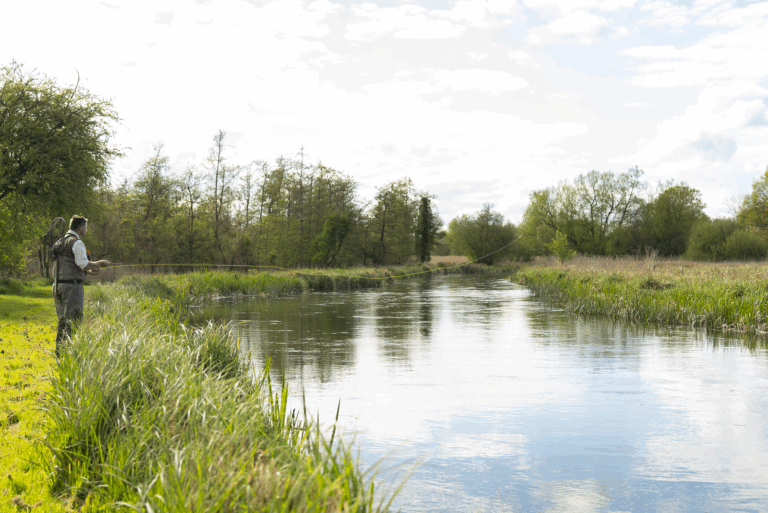
I had a nice cup of tea. I’m just sat outside by the Oakley cabin there. And I’m just jumping into the river now in amongst all the marginal vegetation.
There’s some water mint here and things. Something’s just hatched off the surface there. I’m not sure what that is.
Looks like a little sedge, maybe a granum. And I’ve got a little iron blue dun on to start. Usually pretty good on these blustery April days when the weather’s been like it has today.
It’s just been so wet and miserable. Thankfully, it’s not too bad at the moment. It’s really cleared up to a bit of blue sky.
And all I’m doing is casting a very short line. I’m only using my little free weight here. Got quite a long, for a seven foot rod, I’ve got a nine foot leader on, so I’ve got quite a long leader.
All I’m doing is just casting upstream into likely looking areas. There’s a couple of little holes in the weed I can see here. The parsnip is already coming up.
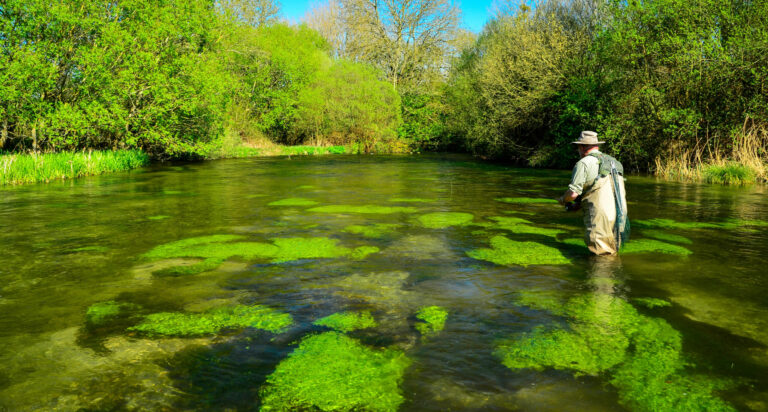
It’s only April, but there’s some really good parsnip on the riverbed here. There’s a beautiful riffle just opposite the hut here. I’m just climbing in a little bit further with every cast, letting a bit of line off.
Oh, there we go. Got one. I’ve got one.
Brilliant. I’m just playing it in. I’m not sure what it is yet.
It looks like a grayling, unbelievably. I’m not sure. Here we go.
Come here. I was putting up quite a good scrap on the light rod I’ve got. Come here.
It is a grayling. Would you believe it on a dry fly? April.
Here we go. Come here. He just came and slapped at it straight away.
I just cast into the riffle. Fantastic. Right.
Well, they are out of season, technically speaking, the old grayling. So I’m going to let them go pretty quickly. This is the sort of time of year when they do tend to start thinking about spawning.
So I don’t want to keep him any longer than is absolutely necessary. Let me just take the hook out. I’m not going to pause for a photo.
I’m just going to let you go, buddy. I’ve just popped him back in the water and he’s gone. Amazing.
What a start. Fantastic. Live on the podcast.
Perfect. That’s exactly what I wanted. Let’s see if we can catch a trout next.
Nice to see there’s a few clearly where there’s one grayling, and there’s almost always more, so there’s bound to be a little shoal of them over there in that riffle. More often than not, the trout won’t be far behind.
I’ve just put my net back in the back of my chest pack there. I’m just going to check that we’re still recording. We are.
That’s good. You can still hear me. I don’t know whether that’s a good thing or a bad thing, but you can be the judge of that.
Let me just have a look at the fly. I think it’s okay. It’s going to need drying out.
Come here. There are you. It’s got stuck in this.
There’s some very early parsnip coming up in the edge here, and it’s just starting to creep into the river, which is good. I mean, that’s what the juvenile fish especially will need for their shelter, is this marginal vegetation.
9:23
Fishing Challenges
Now, the wind is picking up. I’ve no idea how well you can hear me, so I’m just going to pause quickly and then come back to you shortly. Okay.
Well, the wind has significantly picked up, just as I thought it might have died down. I’m not blaming it on the wind, but I’ve just got caught in a tree, so I’ve climbed back out to untangle myself.
I’m afraid that’s very much an occupational hazard of this fly-fishing malarkey. It’s a budding sycamore or something. I’m just pulling my little fly out of it now.
Come here. There we go. I’m not sure how much of this you can hear, but I’m just going to soldier on and hope.
So I’m going to have another go in that little run, where I’ve just snaffled that little grayling, because that was quite fun.
Let’s just see if I can get the line back out on the water, but half the problem is we’re just getting caught in the bank here. I’ll take some more line off and start again. There’s the wind’s just died down now.
That’s a bit more socially acceptable. Let’s try again. Okay, I’ve dried the fly off as well, so let’s have another little go.
I just want to put it in that scene. I mean, literally, that was one of the first casts I made. No, back in the tree again.
You can’t win, can you? Back out of the water. Here we go.
My goodness. In, out, in, out, shake it all about. Let’s try again.
Jump back up to the tree. Same tree, probably the same branch. Incidentally, I just found a fly in this tree from the gentleman that was fishing here on, presumably, from the gentleman that was fishing here on Monday.
So, he’s obviously had exactly the same little go at the same run that I have, because that tree is directly behind the casting line. Okay, I’m going to have one more go at this. It’s quite a tricky little cast, actually.
It’s not dead easy. I mean, if the rod was any longer, we’d be in real trouble, but let’s have a go. It’s all about the challenge, that’s what we like.
This little seven foot free weight is just perfect for this. The Battenkill reel I’ve got on is a little free weight reel. Again, absolutely perfect for this style of fishing.
Nice and up close and personal. I’ve not seen anything rise yet, except the one that took the fly, so, come on. I’m just easing my way back into it.
And I’m wading slightly further out in the river than I was. It’s very windy, and the wind is just carrying the line. Oh, there we go, no.
Something came up for that. That’s interesting, they’re quite happy to rise then. I’m just going to try and roll cast it, just to avoid getting stuck in the…
There we go. Let’s try that. Nothing there.
I’ve stood on a post in the river here. This isn’t so great. And we’ve got…
One of the things I should probably mention is we’ve got little wading zones where you’re allowed to wade, and other zones where you’re not. And we know that…
Or I should say, the Wessex Rivers Trust have seen salmon spawning in this area over the winter months. And so they’re keen not to let us wade, you know, all over the place.
And so there’s been some quite selective decisions made on where we should be wading and where we shouldn’t, just to try and protect those salmon reds. And so we’re in an area now that’s… Obviously wading is allowed.
It’s quite weedy. It’s quite shallow. So it’s not, you know, it’s not impossible.
I’m just trying now to make a couple of casts upstream of myself. That wind is really quite tricky. What I might do is just very carefully wade over the river.
I’m now on the opposite bank, or just nearer the opposite bank. And I do feel like I’ve got a little bit of a better angle on this wind. So the water here is about knee-deep.
And I’m just roll casting and feeling it back. Just going to pause here for a second in case that wind is a bit strong. And then I’ll come back to you.
Okay I’m just wading a little bit further upstream now. The problem I’ve got now, would you believe it, is the sun has come out and the wind has stopped. So it’s like a completely different kettle of fish now.
I need to be back over on the true left bank, so the right bank as you look upstream. That’s where I’m headed. I’m going back to where I started.
And that means that the sun is no longer casting my shadow over the river I’m trying to fish. So they’re a little bit tricky. I’m now casting upstream of myself on this side of the river, the true left bank, nearer to the hut.
I’m casting across my body, with a sort of back hand overhead cast. I’m right handed and casting over my left shoulder, if you see what I mean. So what I’m going to try and do is just plug a series of casts.
I’m going to work my way up into what is the old weir pool before it was taken down.
The Trust have done this large restoration project here and really worked hard to try and improve the habitat for small fish, wild trout, and everything that comes with the chalk streams.
And as a result, they’ve taken this weir out, which they felt was impounding the water, which of course it would have been, and they’ve actually let the water go. And so it’s quite pacy here now.
It’s really riffling along, but there is still the remanence of that old weir, and it’s creating a bit of a nice run here up the true left-hand side. So I’m just gently working my way in.
The sun has just come out, and it’s suddenly turned into the most glorious afternoon. Blue sky. The river’s just turned like sort of a turquoise colour, where the sky is reflecting off the water, and it’s absolutely stunning.
So I’m just working my way into the back of this pool here. I’m not really that hopeful, but it does look really good. So I’m just sort of taking my time.
It needs a bit of an upstream mend there. I’ve got to be careful, because that’s dragging a little bit. I’m fishing a pretty short line over my left-hand shoulder here, just because I don’t want all of that fly line over the water.
These are small wild fish, probably quite spooky. Well, there we go. Tangle number three, this time on my own rod.
That’s not very professional, is it, Jamie? Let’s try that again. Okay.
I’m going to give it a few more casts here, and then I might think about changing the fly over. I’ve been here for, well, roughly as long as you’ve been listening to me. I’ve had to stop a couple of times because of the wind.
But let me just, here we go. The wind is picking up again. I’ve sorted out tangle one and I’ve got tangle four now.
Here we go, it’s come off. It’s just a never-ending, a never-ending job that. It’s okay though, it’s definitely do-able.
It’s not too tricky. Okay, I’m casting back into that pool again now. It’s feeling really very nice.
No, we’re in another tangle. Tangle central today. I’ll be telling myself off when I’m taking that private tuition tomorrow.
The chap I’m guiding tomorrow is a young lad, probably, I don’t know, probably 15, 14, 15. But he’s so keen. He reminds me of myself, and that’s why I love guiding him, actually.
It’s a lot, I’ve guided him a couple of times now, and it’s just been so much fun. It’s really taken me back to when I was his age, and just being super mad keen about anything that swims.
And, you know, he’s asking for a course-fishing tuition next, and, you know, to do more trout fishing and carp fishing, and just all sorts of things, he’s just absolutely mad about it.
And, yeah, it just sort of takes me back to the time when I was his age. Which isn’t all that long ago, really.
I’m aging myself a bit, but, yeah, just can’t wait to get back up there with him tomorrow and have another crack at some of those fish at Manningford there. They’re not for everyone. They’re very, very…
Oh, there’s a fish. Here we go. Oh, I’ve lost it.
Ah, no, no, no, no, no. Oh, that felt quite big. It looked quite big.
Oh, dear. Heartbreak. Oh, dear.
OK, I need to concentrate. Stop talking, Jamie. No, wait, you’re on a podcast.
Carry on talking. OK, I’m back. I’m fishing again.
A couple of false casts to try and dry the fly off. So I don’t need to change the fly, I don’t think. That little iron blue done is working wonders.
OK, come on, then. Come on. Usually when I’m fishing by myself, I sort of hum along to some random whatever’s in my head, some random tune, but I suspect that you don’t want to hear that.
So I’m going to just keep on sort of meandering around the problem and I’m just rambling on. Here we go. I’m in the hedge now as well.
Here we go. Now we’re talking. Right, here we go.
There we go. All right, so we’re off. So I think there are a few fish in here, then.
I’m not seeing anything rise. I don’t think there’s much of a hatch going on at the moment. It’s still very early and I think more than anything, that wind has probably killed it.
But they are hungry. That’s a good sign. I’m just very gently fishing my way into this pool.
I’ve got a very long leader on which, you know, I need really because I’m worried that these fish are going to be quite spooky, being wild and the water is so clear here, they can see everything. I don’t want that fly anywhere near the fly line.
But, of course, that sacrifices a little bit of the sort of the tangle-free properties you get with a slightly shorter and stiffer leader and tippet material. So it’s a bit of a game of give and take here.
You’ve got to kind of win some to lose some, lose some to win some rather, what am I on about? So, yeah, it’s just a bit of a, it’s a bit of a case of making a few compromises. But, it does feel like we might be in for a shout here for another fish.
So I’m going to persevere. The wind’s picking up again, so I’m just going to let that come round. Okay, nothing that time.
Goodness me, it’s windy. I’m still in that first pool, believe it or not. We haven’t even made it past that first riffle yet.
But I’m desperate to just try and get a couple of really good drifts in there. What I’m doing is just rolling it into the seam, followed by a series of upstream men’s, just to kind of keep it from dragging too much.
But it’s really quite an aggressive riffle. The wind is coming over my back, which I’m not too worried about. That would be much better than if it were to be coming from in front of me.
So it’s just a case of using that wind to catch the back cast and then letting it take the forward roll. I’m just conscious that you could get it by any moment here. While I’m talking to you, it’s starting to look a little bit better again.
The sun’s coming out. I do feel like there’s a chance of maybe a fly hatch this evening if that sun persists after a pretty wet and blustery day.
It might be that the fish, the flies, rather take a liking to some slightly warmer temperatures this evening. I’m just fishing over to the left of this riffle now. I’m just feeling it back.
Just a couple of very short casts up into the seam and then just feeling it back between my fingers. Slowly lifting the rod up to take up some of that slack at the same time. And yeah, hoping for a bite.
What we’re looking for is a rising fish and I’ve yet to see one, but we’re going to stick to it. You never know. Couple of little men’s there, just to take the edge off the drag.
And I’m just casting my way into this pool still. I’m sort of in the middle of the river at the moment, casting from my position to the right of the pool first, and then I’m sort of working my way over to the left.
I feel like I’ve given the true left side of the river, the right hand side, as I look at it, I feel like I’ve given that a really good go.
So, I just want to give it a couple more casts and then I’m going to focus more on this left side as it tumbles down into this old weir pool.
Very little signs of life, very, very little signs of life here at the moment, despite having one and losing one already. I’m going to persevere and just see if we can get a fish to come up and rise for my little offering here.
Oh, that’s stuck really well there. That’s really nice. It’s just when you can get it dead in the water, so there’s absolutely no drag.
That’s what I’m looking for. And that one went really nicely. Beautiful.
Although it’s windy, it’s sort of coming in waves, and so we’re getting that windy period, and then it goes really calm and actually quite pleasant for a while, and then it gets worse again after that. We sold her on. Oh, that was a rise.
25:00
Big Grayling Hooked
Something just came up for the fly. I’m not sure if it took it, but it certainly had a look. And again.
There we go. Got him. Ha ha ha ha.
We’ve got him. Yes. Yes, yes, yes, yes, yes.
I’m not sure what it is, but it’s in the weed at the moment. Here you come. Oh, it’s another grayling.
My goodness. I’m grayling fishing today. Okay.
An Oakley beat grayling. Here you come buddy. In the net.
And we’ve got him. Lovely. Well, that’s a nice little reward after a few minutes of really struggling there actually.
Wind was starting to get a little bit, a little bit too much for me. When it dies down, it’s absolutely, really quite pleasant. Oh, the hook’s fallen out in the net.
There goes the fly. So I’m just going to release him. I’m holding his head upstream and he’s just flipped out of my hands already.
So he’s good. He’s gone. There he goes.
He’s just swimming over the, he’s just swimming over the parsnip now. God, that color is gorgeous when the sun comes out. There’s just every now and again, the sun’s coming out behind the clouds.
It’s a very moody day. And when it does come out, it just throws such a beautiful color onto the river. Everything’s just lit up like wildfire.
It really is gorgeous. It’s like looking at liquid amber when the sun catches the gravels here. Truly is special.
Okay, so two grayling and maybe a lost trout, I feel. I’m gonna persevere. I’ll just do a quick cast to see if I could dry the fly off and it’s worked straight away.
So I’m not gonna bother trying to dry it manually if I can do it like that. Nice light cast. Nothing that time.
Usually where there’s grayling, there’s trout. Not always, but… Okay, gotta be a bit quicker than that, Jamie.
Gotta try and take in… Oh, we’re in a tangle. Oh, I love it.
I love it. I’m usually the one that’s undoing everybody’s tangles as a guide, but I don’t mind putting myself in my place every now and again. Let’s try that again.
Okay. Oh, now it’s just… The wind’s completely dropped and it’s just absolutely gorgeous again.
What a special afternoon. Still nothing rising, but they’re willing to come up… Even the grayling are willing to come up for this little iron blue dun I’ve got on.
They’re not worried about it at all. I mean, sometimes it can be such an effective fly this time of year. Oh, there was something else just rose then.
I’m really after one of these large wild brown felt. There was some really large fish caught on the test fishing days last… Oh, there we go.
That’s a better fish. What’s that? Surely that’s not another grayling.
I think it might be. Do you know, I think it is a grubber grayling. It’s fighting much harder though.
Good as me. I’ve so much fun on this three-weight. Come here.
It’s stuck in the flow. I wonder if that’s a trout. That’s fighting much, much more like a trout.
Yeah, come on, please be a nice trout, a nice brownie. It’s fighting a lot like a trout, people. Chugging along in the deep water here.
Putting up a good scrap. Very, very light little rod I’ve got. Come here, please.
Come here. Oh my god, it’s zooming all over the place. Okay, calm down.
Whoa. I might have to follow it downstream. No, it’s a big grayling.
Okay. My goodness. Okay, come here.
This is absolutely stunning. I’m just stood out in the waders in front of Halford’s hut, and I’ve had three grayling to a dry fly. Come to daddy.
There we go. We’ve got him. Beautiful.
That’s a much bigger fish. I don’t know how big that is, but maybe three quarters of a pound or a pound. That’s a really good grayling.
You don’t mind catching them, but I’m just going to get him back as soon as I can, because I’m really only here for the trout. Back you go, buddy. That’s a really lovely fish.
Beautiful markings on it. Little black dots everywhere, all over the sort of a little bar of silver. Interspersed with these little black dots.
It’s just gorgeous. Stunning fish. Oh, there’s a little.
Do you know, I’ve just seen a large dark olive hatch off the surface then right out of my net. That’s a nice little sign. Hopefully, that means that the fish might be a little bit more obliging the later we go into the evening.
Very nice. We don’t mind that. I was also expecting to see that.
We had an absolutely stonking large dark olive hatch on the itch in about a week ago, just over a week ago. And since then, I’ve seen a few hawthorn and a few granum, but I’ve not seen anything quite like that.
So if we see that today, I shall be very, very chuffed. I’m just trying to dry that fly off with a couple of false casts. I’ve walked down a couple of paces, so I’m trying to edge my way back into the pool without being too aggressive.
And I’m looking for anything else that might be interested. That seems to be thinking quite well, actually.
Normally this fly is just such a pain to dry out, but it seems to day, I don’t know if it’s because there’s a bit of a breeze, but it’s really presenting itself pretty well. Oh, here comes the wind again. I spoke too soon.
I’ve got to be quicker on this retrieve to try and take up that slack. If I get a bite from a large trout, I’m going to want to be on it. OK, here we go.
Come on, that was a nice cast. Nothing that time. Let’s try again.
I’m just going to fish over to the right a little bit more. Oh, that’s gone right. That’s stuck right in the seam.
Come on. That looks so good. Nothing that time.
They’ll be looking up at it thinking, what on earth is going on? But we’re going to persevere, see if we can trick another one. I’m still doing this podcast in segments.
I’m sort of recording it for every sort of five or ten minutes and then stopping because I don’t trust the mic not to just cut out. So we’re doing our best. Okay.
I’m going to persevere here just for a few more casts. I just feel there’s a chance of a nice trout in this pool.
But I’m not going to spend all evening here because I really want to get on to some of the bigger and better, well, potentially bigger and better pools a little bit further up the beat. But beautiful to spend a little bit of time fishing in here.
Oh, I had a rise then. Okay. That’s a nice sign.
Come on fish. Okay. Nothing that time.
That was a poor cast actually. Let’s try that again. That wasn’t so good.
Just needs a bit of an upstream mend there just to stop it from from pulling. Oh, and again. Okay.
Small fish, I think. Very small brownies, maybe. Just coming up to try and nip it.
They’re super quick. You’ve got to be way quicker than me to try and get them. Okay, I’m really trying now.
I’m focused. Sorry, people, you’re going to have to wait until I’ve caught another one, until I carry on with the podcast. But now the wind’s died down, it’s feeling a bit better.
I say that and the wind just keeps picking up every time I say that. I’m jinxing it. Right, I’m going to give it a couple more casts here, and then I’m going to mosey on upstream.
Well, I’ve just hooked another grayling, believe it or not, and I’m just about to bring it to the net. I just turned the mic off for a second, just to check that I was still recording, and check my phone and things.
And I had one flick while I wasn’t mic’d up, and sure enough, it came up and nabbed it. So that’s grayling number four, and I think that is time now to move upstream. So I’m just going to let this little chap go.
He’s just got into the net, and the hook’s come out, so let’s let you go. Here we go. Gone, there we go, he’s gone.
Okay, good, so yeah, definitely, I think, time to move. I’m really in search of the trout, as I’m sure many of you guys are listening.
You’re probably desperate to, probably shouting at the, shouting through your earphones right now, saying, for God’s sake, move on. So that’s what I’m gonna do. I’m gonna reel in, and I’m going to step out.
There’s a little no-wading zone in a moment, so I’m gonna step out before I wade past it, just in case I miss it. I’ll make sure I don’t go trundling through any of that. So let’s wade back down the way we came.
It’s probably, I’ve only made it about 30 yards, less than that. And, yeah, I’m just gonna clamber down, stream here, get up on the bank of the way I came in. Oh, there’s a deep hole, my goodness.
He went a long way downstream then. He ended up in the solent. That wouldn’t have been too funny.
OK, so climbing out. I’m back at Halford’s Hut now. Just absolutely gorgeous here.
The gardens are being looked after again by the trust, and they do look fantastic. I just caught my fly in my jumper. Yeah, so the gardens are looking very colourful.
I’m just walking upstream now to the willow tree, which was planted in memory of Ralph Collins, the ex-river keeper at Mottisfont between 1962 and 2004.
And yeah, absolutely, absolutely beautiful little willow tree this is going to be when it grows up. It’s still only really a coppice shrub at this stage, but yeah, it’s going to be really nice.
Just going upstream now to what we know as the no wading zone. Okay, so I’ve just come a few yards upstream, and we’re now above that weir pool now, on some sort of slightly deeper water, I would say.
And it’s much wider here, much less pacy, a bit slower. But it’s sort of gliding rather than riffling here, so it does feel quite good for presenting a dry fly. The cast is a tricky one again, very tricky.
But I can see what looks like a couple of fish sat out over the gravels in the middle. So I’m just going to try and lay a couple of casts over the top of them and just see if I can get them to rise. That wasn’t quite so good.
There’s a little gravel patch out there which looks absolutely perfect for a fish to be holding up. And I think, I’m sure that’s a trout. I can’t quite see.
The water is pretty clear, but it’s still tricky. Okay, nothing there. Let me try again.
Oh, that was nice. That looks good. Nothing that time.
Yeah, that also looks quite good. Just cast it a few feet upstream of where this little gravel hole is. Yeah, that’s looking very nice.
That’s a much better cast, that one. Nothing that time. I’ve got quite a bit of stuff behind me, so I’m being careful not to let the back cast take too much of the fun out of it.
Nothing rising for that, so it might be a case of changing the fly, because I’m sure that that is a trout. Come on.
I’ve had three or four really nice casts just upstream of that now, and I’m not seeing too much enthusiasm from what I think is a trout.
Mind you, there’s not a lot hatching, so I’m asking quite a lot of it to rise up for nothing, but it does feel good. There’s a little bit of sun out.
The trouble we’ve got here is that the wind is just playing havoc with the line in the air, but I’ve got to keep the line higher than I’d normally like because we’ve got so much stuff around us. Trees and shrubs and marginal vegetation.
The reeds are growing up now, and it’s all starting to look very pleasant here, but it’s making it quite tricky on the old fishing front. That was a nice cast, but not quite in the right place, I don’t think.
I need to just try and get a little bit further upstream. Oh, that looks better. Okay, here we go.
That looks much better. Take up the slack. Still moving with a bit of pace, you know, this water, but it’s much more gliding.
It’s much smoother feeling, much more temperate. Here we go. That was nice.
I’ve just managed to kick the, oh, there we go. No, I missed him. Oh, no.
Something just shot out of the weed and came up and grabbed it. Oh, dear, that’s painful. That was a really sharp little tape, very quick.
Just came up, and I struck into nothing. I’m sure it’s those small, small grayling. It could be trout, but whatever it is, it’s tiny.
So much fun, though. Okay, I’m going to have a couple more casts here. I don’t feel too inclined to change the fly yet.
I’m getting the odd rise still, which is nice when I was catching those grayling down below the weir there. They were all rising to that iron blue dunes, so I don’t mind too much. That was a nice cast.
A little bit too pacey the way I position that. I think I can do better. Okay, that was okay.
So we’re going about a foot or two upstream of this little gravel patch here. It’s a very tricky little cast to make. Okay, that’s better.
I’ve worked my way over the other side of the river slightly. There looks like a little gravel run. Just the other side of the weed in the middle, which looks like it should be holding fish.
I can’t see anything, but there’s a slight… There is a very, very slight tinge of colour in the water where we’ve had a bit of rain, and the chalk streams almost never colour up.
But here, when you’re down on the middle test here, it’s got quite a large catchment, and so it will be taking on a lot of rainwater that we’ve had overnight. That felt really good, that one.
I’m quite surprised that I’m not seeing any signs of life here. Very little fly life around, I think. I’ve seen a couple of large dark olive hatching off, but really very little to go on.
So I’m going to persevere. I’m determined not to use a nymph. I’m trying to do things as by the book as I can.
Of course, you are allowed to use nymphs here, and the chaps that fished on Monday, I think it sounds like they caught most of their fish on nymphs, which is good.
But I’m really keen to try and get one of these large wild brown trout off the surface. Still early in the year, but you’ve got to be in it to win it. That’s what I say.
Okay, I just had to double-check we’re recording, and we weren’t, so good job I did. I’ve just hooked a really large fish. Stay tuned.
I’ve just moved just upstream of that willow bush. One cast, perfect. Stuck in the seam, fish came up, took it, fish on.
I’m now playing it in the deep pool where I just was, and it’s really rocking with this little free weight. I can feel absolutely everything, and I’m very nervous. The wind’s blowing.
I’ve got such a long leader on, I’m already on the leader, because it’s nine foot, I’ve got a seven foot rod. It is fighting like hell down there. Oh my goodness.
I have to take a little bit of line off, just so that I can give it some. Okay, I’m not sure what it is yet. I really don’t know, but I’m hoping it’s a large trout.
It could be a big grayling though. I’m very excited to see what this is. Come on.
Oh, there it is. It just came up and splashed on the surface. Looks like a trout.
I can’t tell. Please don’t go too far downstream. Whatever it is, it’s very large.
If it’s a grayling, it’s enormous. If it’s a trout, it’s equally big. Oh my goodness, it’s a grayling.
It’s a really large grayling. Okay, that is a beautiful fish. Come on, come on.
That must be one of the biggest grayling I’ve ever caught. Okay, I’m starting to feel a bit nervous because the flow is really pulling. Okay, come on.
It’s got its big dorsal fin up like a sail and it’s just using it to glide across the flow. It’s so clever. It’s really trying, it’s really trying to pull me away.
That is an enormous grayling. Come here, I think this could be the fish. It’s jumping around like a trout.
It’s crazy. This could be the fish that Neil and I saw when we walked here, when we walked here on the last podcast, Episode 3, just talking about and this feels unbelievably heavy. Crazy how it’s just clinging to the bottom.
It just came up and slurped an iron blue tongue. Square off the top, it couldn’t be any better. Come on, that is a really quite large fish.
I’m just getting slightly nervous about getting this to the net. I can’t do anything with it. Okay, come on.
Come on now. It’s big, it’s beautiful. I’m so glad I got the orvus net now.
The big pan. We’ve got him. We’ve got him, folks.
Oh, that is a colossal grayling. What a beauty. Absolutely gorgeous.
It’s a really long, dark fish. Massive dorsal fin. Absolutely stunning example of a chalk stream grayling.
I cannot describe to you how elated I am. That is absolutely brilliant. OK, I really must be quick.
I just want to take a couple of quick photos of him in the net, and then I’m going to let him go very quickly because, technically speaking, these guys are out of season.
So obviously you can’t do much about it when you’re fishing for trout, and they come up and take an iron blue done off the top. But let me just… I can’t believe it.
I’m just going to try and take the fly out of his mouth. It’s quite well hooked. There we go.
It flies out. Okay, he’s still in the water. I’m going to have to pause the podcast, folks, just while I take a photo, and I’ll be right back with you as soon as I’m ready to let him go.
My goodness, the color on his dorsal is just sort of an orange, red, fire-like color. It looks like it’s on fire. Absolutely stunning.
I’m going to take a couple of quick photos. I’m going to release him, and then I’ll bring you back into the fold. Give me a moment.
I’ll be right back. Oh, what a moment. Well, I mean, I don’t know what to say.
Part of me was hoping that it was going to be a really large trout, but to catch a large grayling like that and looking as beautiful as it did, I mean, I can’t complain. It was an absolutely stunning example of a chalk stream grayling.
I’m so pleased. It put up a mental fight. To catch it live for the podcast as well is pretty cool, so I’m really chuffed.
Mission accomplished as far as I’m concerned. But the icing on the cake would of course be one of these elusive big trout. So I’m going to persevere.
I’m just going to cast back roughly to where I hook that grayling. And just see, I’m casting now quite a good way, two-thirds over the river to where I hooked it.
And incidentally, it’s where Neil and I had seen a couple of large fish last time we came. So it’s almost unsurprising that it was to get caught from there. With a nice long cast like this, you don’t feel like you’re doing any damage.
You just, you know, you can be nice and quiet. As long as you can get a nice, delicate presentation at the end, you’re so far from the fish, you don’t feel like you’re spooking them at all.
So I’m just making my way a little bit further over with every cast. But yeah, absolutely blown away to have caught that grayling on such a light tackle. Yeah, it’s just so much fun.
So what a way to spend an evening. And somebody will surely be very sorry that they weren’t able to buy a day and enjoy this for themselves.
This will be the only chance that I get personally to wet a line here this season before I actually start guiding people here.
And so it’s nice for me to have a bit of a recce and get to know the place and understand where fish are holding and where we might spend most of our time, we’re on limited time with a guest.
So yeah, absolutely, absolutely brilliant way to spend an evening. I’m very pleased to, I feel quite lucky to be able to come down like this.
I’m sure Neil won’t mind me saying it was a bit of a last minute decision, really, because we noticed that nobody had booked this day. And I was trying to sell it, but for some reason nobody wanted the 15th of April.
There you go, I’ll take it for myself. Thank you very much. And so here we are, I’m just feeling my way down.
Having a couple of casts a bit further up. That wasn’t so good. It may not matter though.
Doesn’t look too bad. Just trying to get that fly to stop dead in the water. I want the water to sort of take it naturally.
It’s quite tricky when you’ve got all that fly line out. And just to try and add some context to this, the flow here is coming from about three different places.
And so trying to judge which way to mend the line is actually quite tricky, but makes it really interesting style of fishing. It’s quite proactive, quite busy because I’m constantly recasting.
I’m not getting much time with the fly on the water, but I’m doing my best just trying to keep up with the flow. Trying to make that fly behave as naturally as possible on the surface.
And then we can, you know, then we’ve got the best chance, if we can just put that in front of a fish, you’ve got the best chance of something coming up and snatching at it. And that’s exactly what’s been happening.
I’ve now had five grayling and no trout, so I’ve really got to up my game here a bit. That wasn’t great, that one. Okay, let me see if I can get a bit further out.
It’s actually casting quite a long way now. Trying to get sort of three quarters of the way across the river into the sort of the main flow on the opposite side.
I’ve got a bit of space to back cast here, so that’s nice, but I’m not blessed with casting space, it has to be said. Just a good job I got a short rod with me. That was a nice cast, there we go, that’s a bit better.
Feel a little bit better about that. It’s just a constant series of mends you’ve got to make here to keep the fly line turning over so that it never drags too much on the water. Okay, that was okay.
So I’m changing between a downstream mend and an upstream mend, just trying to keep the fly line from dragging. And it’s sort of working, but I’ve just got to be, oh, hang on a minute, what happened there? That was strange.
I think I had a take, you know, just without seeing it. How weird. Okay, let’s try that again.
So I’m still persevering in the same pool I caught that large grayling from. I just feel that there’s a really good chance of a big trout here. It is one of the pools that we’ve seen large trout in over the last few times that we’ve visited.
So I know that they like it here. I’ve just got to get the right presentation and hope that one’s up for a big juicy iron blue dung. Come on.
I’ve not changed the fly yet since I’ve been here. The wind’s died down. The sun’s come out.
It’s really starting to look pretty special. So now I’m casting most of the way over there, putting the fly right in the seam on the opposite side. But I’ve got flow on my inside bank as well, and so it’s requiring a bit of clever line management.
But what I’m doing is mending it upstream first, then downstream, then upstream again. Just trying to keep it dead in the water for a little bit longer. There’s a bit of glare on the water.
I’m really struggling, actually, to see the sun, believe it or not. It’s just absolutely glorious again. And it’s backlighting the opposite bank.
And it’s quite low in the sky, but it’s throwing quite a bit of glare over the surface. So it’s quite a big double haul I’ve got to cast over there, just to get the line where I want it. Let’s try that again.
No, tangled. Maybe not. I’m okay.
I think I’ve got out of that. Yeah, so it’s a tricky old cast, but it’s tricky for different reasons than for earlier. Earlier, the problem was that I didn’t have space to cast.
Here the problem is that I’ve got to cast quite a long way for a short rod. So it’s all these little challenges that are really kind of making it quite an interesting bit of fishing this evening.
It’s so nice to be on the river on my own time for a minute, you know, after a few busy days at the start of the season. And a pretty well booked out mayfly period, etc. It’s just lovely just to spend a few hours under my own steam.
Okay, so I just thought I’d take a break from the fishing and I decided to come into Halfords hut for a cup of tea.
54:31
Halfordʼs Hut History
And I thought I’d talk a little bit about what’s going on in here. So as I think I mentioned earlier, we’ve got some beautiful photography from Halford himself hung up on the walls.
We’ve got some old fishing scales, some cast iron ones, you know, original Salters, they’re the real deal, some proper antique scales there. And then in one corner, we’ve got the teas and coffee making facilities.
So fresh coffee, we’ve got some milk, some tea, a cafetière, a kettle, and obviously some fresh drinking water. And so there’s cups and glasses here for everybody that wants to use those.
And then on the desk, we’ve got a little tablecloth, which is lovely, and a vase of flowers. But next to them is the folder of information, which I think will be very useful to anybody that’s coming here.
Obviously, there’s a bit of a welcome from me, just saying thank you very much for your booking and welcome to Mottisfont Abbey.
And then there’s a load of information, some really cool stuff about the beets, the style of the fishing and how it’s changed.
And then a little bit further on, we’ve got some beat maps, which give a really kind of in-depth analysis of where your time is best spent on the river.
So if you’re looking at the rectory beets and you’re thinking, well, that could take me all day, then if you have a quick look at the beat map that Neil Swift so beautifully drawn, then it very quickly works it all out for you.
And then just past that, we’ve got a couple of sort of extracts from, well actually photocopies from some writings that were in the hut a number of years ago.
And we found them, we photographed them, and then we had AI, believe it or not, write them out again for us from the photos. So we’ve now got perfect copies of them.
And there’s a couple of paragraphs here that were written about FM Halford and his tenure here at Mottisfont. And I thought I might just read you one little paragraph from the abstract. So here it goes.
Halford believed that the best fishery was one that maximized numbers of native wild brown trout, but accepted the necessity of judicious stocking of two-year-old browns of around one pound to one and a half pounds, mainly to take fishing pressure
off the wild trout population. He introduced 5,000 alevens into the Oakley stream in 1906, and was gratified to see the consequent increase in small trout.
Catches increased year by year, but by today’s standards, the water was very lightly fished, and the fish, as he intended, were small and difficult to catch. The largest trout in Halford’s meticulous records for 1911 and 1912 was just three pounds.
So that’s actually quite a large fish in today’s money. You know, over the years there have been lots of fish stopped over the whole river test, you know, and that’s part of sort of common practice.
But here at Mottisfont, the fishing has taken a bit of a turn. There’s been this cessation in the stocking policy, and so it’s been completely stopped, in fact.
And so what we’ve got now is a completely wild fishery or as close as one can get to it here on the river. And so the fishing has much changed as a result of that.
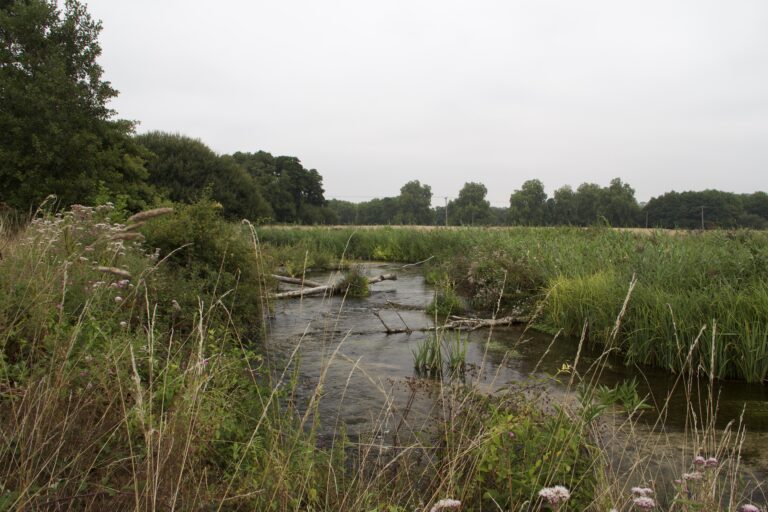
And looking out the window, where I was just fishing a little way upstream, I can see the logs in the river, and it reminds me that actually, you know, some of that wild fishing is exactly what I enjoy.
So I’m really chuffed to be here and fishing in the footsteps of the great FM Halford. So anybody that’s fishing here will be able to read that abstract in a bit more detail.
And then there’s another bit of information here about Halford’s time taking photographs. He was actually quite an accomplished photographer, and he would, let me just find it here. Yes, I’ll read you this little bit because it’s quite interesting.
Amongst the collection are six mahogany boxes of quarter-plate glass color slides or auto-chromes, each one carefully indexed in Halford’s hand.
Apart from their intrinsic historical interest and the connection with Halford, they form an important collection of some of the earliest color photographs taken by the auto-chrome process, which was the first commercially available means of
capturing color images. The auto-chrome prints here in the Hokeley Hut were all taken by Halford between 1909 and 1913, and are displayed by the kind permission of his great-great-granddaughter, Johanna Halford.
And so there’s a little bit here about the index entries, and if I read them off, it actually describes exactly what’s on the walls here inside the hut. And I’ll just pick one as an example.
There’s a picture here of three male trout lined up one above the other. One pound nine ounce, one pound six ounce, and one pound four ounce trout. And then beneath it, there’s a picture of one female trout of one pound and four ounces.
And so there’s a great number of photographs here, some of the old oak tree at Oakley Beat. There’s some of the bridge over the Oakley Stream, and there’s plenty, and they’re really, really, really sharp photographs.
You can’t believe that they were taken so long ago. So it’s absolutely brilliant to have them inside the hut, and we’re chuffed to be able to have them as part of the history here.
So there’s a little bit about the rules and things later on, a few more maps for showing the no wading zones. And also there’s a bit of information on the best practice for catch and release.
Obviously all of the fishing here is catch and release only now. So it’s an exciting turn of events here at Mottisfont. And this is the first year that we’ll be trialing this sort of wild fishing thing.
And so it’s going to be really exciting to see how it’s going to go. But I think going on today’s successes this evening, I think it’s going to be pretty good.
So I’m going to have this cup of tea and then we’re going to get out on the river and do a little bit more fishing. Well, I’ve just had my cup of tea at Halfords Hut here and I’m ready to go again.
1:00:44
Tackle Leader Repair
But one thing I’ve got to do before I go is take that little wind knot out of the leader. So what I’m going to do is pop my phone back in my pocket whilst it’s recording, and then have a look at the leader.
And in fact, I think I’ve got two wind knots there. I do. So what I’m going to do is quite simply, it’s a long tapered leader, it’s a 4x tapered leader.
What I’m going to do is cut it above the second wind knot, and then I’ll just quickly loop on, I say loop, I’m going to tie, I’m just going to quickly tie on another length of tippet material, probably in the 5x or 6x range.
Let’s see what I’ve got in the pouch. So I’ve got my chest pack here, I thought now would be a good time since I’m going through it, looking for some new tippet to talk about what I’ve got.
So it’s this fishpong chest pack, fantastic bit of kit, super light, absolutely pins to your body, it hugs your chest, which is what you want, you don’t want anything sort of flapping around.
Then on the front of it, I’ve just got my spools of tippet material, which is absolutely essential. I’ve got them from 3x all the way through to 7x, rarely go above 7x, for all the obvious reasons, it’s extremely light. But it’s there if I need it.
Occasionally, I’m taking clients onto some of the wilder beats where you just cannot get a bite, and you need to just sort of find things down a little bit.
And if we ever get down to 7x, then it’s obviously been a pretty hard day, but it’s there when we want it.
Next to that, I’ve got my zipper, and the zipper’s just got my pair of snips on the end of it, really handy just to have, obviously, just to be able to come up and grab the end of a tag end bit of line and just snip it off.
On the left hand side, I’ve got pinned to the side of the bag, but still quite easily accessible are my forceps.
Occasionally, you get a fish that you just can’t unhook by hand, so I’ve got the forceps handy, and they’re on a little elasticated bungee cord so that they don’t go flying off when I leave them behind somewhere. I know what I’m like.
I’ve lost a pair of forceps more times than I think I’ve actually brought some with me, so worth having them tied on. I’ve obviously got the fly box inside, and I’ve got a knife at the bottom there just in case.
Fly box has just got a bit of everything in. This is a fly box that I use to demonstrate most of the time, so I’ve got a few nymphs, a few wet flies, a few dries, a few mayflies. A bit of everything really, clinks.
What have I got? Iron blue duns, parachute adams, black gnats, sedges, bubble wing caddis, daddy long legs, blue winged olives, just a whole mix of things.
Then in the sinking fly section, I’ve got some flashback PTNs, some Frank Sawyer PTNs, some still water flies. I’ve just got a bit of everything really just so that I can show what they might like to use.
Obviously, we’ve got plenty more boxes in the car, but I try only to carry the bare minimum with me when I’m actually out and about. In the front pouch, I’m just unzipping things. In the front pouch, I’ve got just a load of pre-tied tapered leaders.
So I normally always just go for 4X, just to keep it really simple because 4X is pretty mid-range, and you can tie a lighter tippet to a 4X. Very rarely need to go heavier than 4X.
So I generally just go for 4X all round, and if I want to go thinner, I can tie a little bit of tippet on the end in the 5 to 7X range. But yeah, I’ve got loads of those 4X tapered leaders in the front pouch.
What I’m gonna do now, having just cut that 4X tapered leader back, is fish out some, probably gonna go for the 5X, if I’ve got any left. Let me have a look. Yes, I do.
I’m gonna pick out the 5X. I’m gonna take probably two feet of that off, and this is where I need to use my mouth, really. I’m one of these people that uses their teeth.
But I’ve just caught it with a snips, so that’s fine. I’m just gonna tie a 3X surgeon’s knot into this, and get this all tied up nice and neatly, and extend the life of the leader a little bit.
Buying leaders is expensive, but if you can extend the life of them every now and again by tying a fresh tippet on the end, you know, you can make your money back, I feel.
And it’s just so convenient, especially when you’re guiding as many days in a season as somebody like me might. You know, it’s just impossible to keep up with leaders getting caught in trees and things when you’re tying them yourself.
So much easier just to buy them pre-fab and make the most of them whilst you’ve got them. So I’m just tying this knot now. I think I’ve done those three turns.
So I’m just going to wet the knot and bringing it up to my mouth. There we go. And I’m just going to pull it all tight.
So nice and gently cinch that down. Okay. I’m just going to bring it up to my mouth again, just to grab the tag ends between my teeth and just try and pull those a little bit tighter too.
There we go, and that’s a really nice and neat knot. I’m quite pleased with that. And so, if you’ve got 4X and 5X put together, it’s quite easy to snap it at this point, so pulling it tight is an important part, but you can overdo it.
I like to make sure, though, double sure, that it’s not gonna break on a big fish.
And that’s why I’m quite keen not to go down to 6 or 7X, unless I’m absolutely desperate, because if you can get away with a 5X or a 4X, then, you know, you’ve just got a little bit more confidence in what you’re using at that end of the set up.
So that’s that tied up. Now I can run my fingers to the very end of it and fish out a brown spanker. I’m gonna use another iron blue done, I think.
There’s no reason to change. Let me go into the fly box and fish it out. Here we go, so I’m just going to tie an eight, I actually use an eight turn half blood knot here.
Once you’ve cinched it down, it’s unbreakable. The only problem with it is you can, if you’re not careful, kink the line just as you’re tightening it in, so you just have to be a little bit wary of what you’re doing.
I’ve just wet the knot again, I’m pulling that down tight, but the beauty of it is once it is tight, it’s such a neat little knot, and as I say, very, very strong. So I’m just going to bring it up to my mouth again and pull the tag end.
Yeah, that’s nice. Very pleased with that. And then I’m going to cut it.
Just bringing the snips up, and the snips are blunt. I don’t know why that’s not cutting through that 5x tip. Either that or the 5x tip is stronger than you think.
Okay, there we go. We’re all tied up, ready to rock and roll. So I’m just going to put that on the rod, and I’m going to grab the net, and that’s all I’m carrying.
Just this chest pack, my seven foot three weight, and the net slots into the back of the pack as it comes over your shoulder. So it’s just absolutely ideal. Just shut the cabin door.
The sun’s out, the wind’s died down a little bit. And it’s absolutely glorious. Let’s go and find some fish.
1:08:58
Upstream Salmon Parr
Right, I’ve come a good way upstream. I’ve come above the pool that we caught the big grayling from. I’d love to have caught another one from there, but it just didn’t seem to be anything interested.
But what I’ve done is I’ve come a little way further upstream to the next pool, which is being kind of scoured out by a large bit of wooded debris that’s been thrown in from the opposite bank.
And well, I say thrown, it’s been placed there quite strategically, I think, by the Wessex Rivers Trust, who’ve been trying to improve the habitat on this little stretch.
What I’m going to do is because the sun is now right on my face, I’m going to kneel down. I’m now on the moan path, knelt down. I’m just going to crawl on my two knees into position.
I’m sort of in the marginal fringe and using that as a bit of cover, I’m climbing my way into the pool. I don’t want to be in the waders here, so what I’m going to do is fish the back of the pool first. I’ve got a nice long leader up.
Just see if I’m going to rise up. I’ve got absolutely no casting space behind me, so it’s going to be a series of very, very short overhead casts initially, until I can get some line on the water and roll cast. Okay.
Very, very gently initially. Okay, that’s good. I’m just fishing the back end of the pool first.
Just letting the fly dance along the surface, nice and gently. I’m really being very, very careful here not to make any sudden moves. I don’t want to be too quick about this.
I’m just following it with a rod. I’m not letting any line out or bringing any line in.
I’m just throwing the line out over the water, trying to get the fly to stick in the seam that’s coming down the sort of middle of the river here, and I’m fishing in the eddy. It just looks so inviting.
The way that the sun is hitting the water is such that it’s quite glary, and I can’t really see into it. So I’m trusting my gut here with where I should be casting. And I’m just trying my hardest not to get in a tangle like I’ve just done.
So, let me just get that undone. I’ve just crawled forward, put the lob behind me and crawled forward to untangle it. The beauty of having such a short rod is you never have to go far.
These little seven footers are just magical for this style of fishing. Up close and personal, just how I like it. Really is very, very exciting stuff.
OK, there we go. Let a tiny bit of line off. Oh, we do like the sound of a batting kill, don’t we?
Here we go. So, well, that wasn’t so good. I’ve just wrapped it around the branch.
It’s Tangle City here today, folks, I tell you. Let me just snap that tiny little twig, bring it towards me. There we go.
Ultra tricky conditions this, but I think there’s a chance of a fish out of this pool, so I’m going to really take my time here. Such a picturesque little spot. The sun’s out, the wind’s dying down a bit.
The bird life is just, well, it’s just electric. It’s like an orchestra. It’s just absolutely stunning here.
Okay, so, yeah, very tricky little cast again. But we’re there now. And I’m sort of holding the rod out at an arm’s length to try and get everything to unroll away from me over the water.
Following the fly line down with the rod tip. Forgive me if I’m, my speech is a bit broken, but I’m trying to concentrate.
And part of this is just trying to work out how not to get in a tangle like that when you’re fishing, when you’re fishing across your body. I can’t fish over my right shoulder at the moment. It might be that I need to fish with my left hand.
I can do it, but I’m not very accurate, and I’m certainly not ambidextrous. So let me just see if I can cast with my left hand here. I can cast over my left shoulder with my right hand.
I’m just getting entangled. Let’s do a left-handed cast. Make sure you’ve got the line in your fingers, Jamie.
That’s rule one. Okay, here we go. I’m left-handed now.
This is crafty. Oh, something rose for that, I think. That was interesting.
Take a bit more line off there, will it? That really looked like a fish had come up for that. Okay, I’ve just let a bit of line off.
I’m now casting in my left hand, which I am completely unnatural at, but it sort of feels like it’s working. Hang on a minute. I’ve just caught the edge again.
Oh, the joys, there we go. I’m out. Now I’ve got to pull some line through.
This is just beautiful. Truly, I’m not sure if the bird song is being picked up properly on the mic, because I’ve got the little muffler thing on there, the little squirrel.
And I’m not certain that it’s going to be picking up the bird song, but I really hope it will be. It’s just so pretty here. Okay, there we go.
Right, I am actually fishing something like what you might call effectively now. So I’m casting in my left hand, switching to my right, just so that I can actually get the long cast out of the knee without tangling. That feels good.
Come on. Again, nothing rising yet, but I think that was a fish that came up earlier for the fly. Oh, the old left hander.
Bit more line out, I think. I’m just slowly edging my way into the pool a bit. No, that wasn’t very good, Jamie.
Oh yeah, that’s more like it. There we go. Mend the line upstream, I’ve swapped into my right hand.
Come on, baby. Nothing. Nothing’s even rising at the moment.
Come on. Oh, that was better. Go left handed.
Nothing. I’d really like to see them start rising. That would be awesome.
There’s something about being on your hands and knees beside a river. The sun out, it’s just warm, it’s just lovely, actually. The temperature is just perfect for being sat here.
There’s a bit of sun on my face, which I quite like. After a very blustery, windy day, it’s been pretty horrific today. But it’s really starting to feel like spring again this afternoon.
I’m really not seeing any signs of activity anymore in here. I’m kind of switching, I can’t decide whether I’m good enough in my left hand or not. That’s something I’d quite like to…
I wonder if there are… If you are listening to this and you’re an ampidextrous person and you’re able to fish effectively in both hands, I’d be really interested to hear how you really do it, because I am certainly not good enough at this.
Okay, I’ve gone way too far over there. I was trying my luck. I went for a bit of a long cast then, which was a bit…
That was a bit audacious, I feel. Okay, so no signs of Mr. Trout yet.
I’m not seeing any signs of life, really, as far as the fishing is concerned. I mean, everything else is just electric, but the fishing is really pretty tough. Okay, here we go.
I mean, the problem I’m having now is that wind’s picked up. And if I thought the wind was hard to deal with in my right hand, it’s even harder to deal with in my left, I can tell you.
I’m just very delicately rolling that fly over, just turning the whole thing over into the seam there. Oh, that’s nice. Just needs an upstream mend a little bit earlier, I feel.
No, I nearly ended up in the tree there. The wind’s picked up. Okay, I’m managing, but only just.
Oh, here we go, got one. Yeah, that’s a fish. There we go, that just came up out of nowhere.
I wasn’t even expecting it. Guess what, folks? It’s another grayling.
I can’t stop catching them today. Is it a grayling? I think it’s a grayling.
I can’t get in the water here. There we go, I’ve got him. I’ve got him.
Just bringing him to the edge of the water. Is it a grayling? Is it a grayling?
Yes, it’s a grayling. Is it? No, it’s not, do you know?
Do you know? It’s not a grayling at all. That is not a grayling.
That is a salmon par. Now, I know somebody that will be very interested to hear about that. Let me take some photos.
Well, I just caught a small salmon, which was quite unexpected. Let him go pretty quickly. I took a quick snap and then let him go in the water.
So really cool to see those guys. Obviously, there is some recruitment here, which is lovely to see. He’s got quite a journey ahead of him.
If he’s going to Smelton, go to see. Let’s see how long he can make it for. Unfortunately, the Atlantic salmon populations, particularly the Chalkstream Atlantic salmon, are really, really struggling at the moment.
It goes without saying that that is a very rare fish indeed. So I’m quite pleased that he’s paid us a visit. But equally, I hope that he survives as long as possible and maybe one day returns here to spawn himself.
So fingers crossed. Anyway, back to it. I’m going to persevere in this pool for a little bit longer.
And then I’m going to think about moving up. Okay, so I’m now, in order to make this cast, I’m now throwing the line over my left shoulder behind me, in a reverse overhead cast.
So I’m actually turning to face the bushes behind me, and then throwing the line on the back cast over the water, just to try and get it out where I need it to be.
Just otherwise don’t quite have the, don’t quite have the ability in my left hand to get the fly to turn over. There we go, that was much better. Okay, I feel like that one’s, that one’s gone a little bit neater.
I think I can do better than that, but we’re going to try again. Here we go, oh, no, you would have heard that. That’s a tangle.
Oh, I love it. Here we go again. We’ll keep persevering.
Okay, so I’m still in that little pool between the two big lumps of wooded debris. It’s a really attractive little pool. I mean, it’s just so fishy.
But there’s definitely a bit of a learning to be done on my part about how to go about fishing this effectively, because I don’t feel like I’m quite there yet.
Part of it’s because I’m kneeling down, I think, and I don’t feel like I’ve quite got the movement I would like on the knees. But there’s got to be a way to fish this a bit more effectively.
The problem I’m having is I’m getting tangles where the wind is just carrying the line into the rod as I’m casting at funny angles to the water. So I just need to get my head around how to approach this a bit more effectively.
Because when I bring a client here, it’s going to be one of the questions I imagine that they’ll have is how to go about approaching this pool. So I’d like to get my head around it now if I can. And that is exactly what I’m going to try and do.
I’m just untangling that little tangle I’ve got. And then we’ll go from there. Okay, there we go.
There we go, right, we’re fishing again. I’m gonna stand up now. I feel like I’ve done a little bit on my knees, which is fine.
But I’m now standing up, just to see if I can concentrate a bit more on the cast. I’m throwing the cast behind me, over my left shoulder. Sort of a reverse overhead cast still.
It’s the only way I can get it. Quite where I want it. OK, not perfect, but we’re going to persevere.
That’s better. Yeah, nice. Good.
I’m really keen to try and get this fly right in the right areas. Very little fly life coming off. I think it’s still slightly too early.
That’s nice as it feels here. I’m still sort of semi-confident of a bite. Just waiting for something to rise.
Well, I came about two-thirds of the way up the beat in the end, and I finally caught one of those beautiful Mottisfont Wilde Brantrout, so I couldn’t be happier. It was absolutely textbook.
I found him rising in a little riffle behind one of the logs that have been put in here. And he was rising quite readily, but I couldn’t work out what he was feeding on.
So I thought, well, rather than go in there all guns blazing, I’ll find things down first. And so I went down to a 6X tippet and a very small parachute Adams, which imitates most things and sits quite low in the water.
So I was quite pleased with the presentation. And sure enough, first cast, I managed to stick it right in the seam where he was rising. And he came up first time of asking and took it.
So absolutely delighted to hook and to land him. He’s only a small one, but really pleased to finish it off on a high note. It’s been quite tough this evening, not going to lie.
It’s been tricky. The wind’s been very difficult to deal with. And then obviously you’ve got all of the other challenges that come with fishing here.
It’s quite overgrown in places. There’s lots of trees and shrubbery to look out for. But it makes the fishing so interesting and it’s a real challenge.
But when you do get it right, it just makes it taste all that much sweeter, doesn’t it? So really chuffed with the way that the evening’s gone. And to catch those grayling early on has been a real highlight as well.
But the sun’s going down and it’s definitely starting to get cooler now. The wind isn’t getting any lighter, to be honest. So it’s definitely time to call it a day.
But I thought I’d quickly talk about what I’ve got planned for the rest of the weekend. So unfortunately now, it’s 8 o’clock, bang on. So I’ve got to go back to the office and probably do two or three hours more work.
So it’s going to be a late one for me. And I’ve got an early start in the morning to try and get up for a private tuition, which is just about to be confirmed. So hopefully we’ll do that.
I’m really looking forward to it. If we can do it, it’s with a chap that I’ve been guiding recently, and he’s really improving. He’s only a young lad, so really nice to see the next generation kind of coming through as well.
And I get a lot of fulfillment out of teaching the younger guys as well. So I’m really looking forward to teaching him. Hopefully we’ll catch some more monster trouts, like the seven-pounder we caught a couple of weeks ago from Manningford.
So we’ve got that tomorrow, and then Friday’s gonna be a bit quieter for me, which is nice. I need a few hours in the office uninterrupted to ping off a few emails and make a few phone calls.
So I’m actually looking forward to Friday tucked up in the office. And then Saturday and Sunday are gonna be really exciting. So Saturday I’ve got a private tuition with four chaps who are coming down from London, and they’re staying in Stockbridge.
We’re taking them out onto the Werewell Estate for their first ever fly fishing tuition. And then once we’ve got them up to speed, we’re taking them out on the river on Sunday.
So they’re coming to a private beat of the main river test, which is usually pretty good for beginners. It’s quite easy going, quite relaxed. So it should be a lot of fun.
We’re looking forward to that. We’ll probably grab a pub lunch at some point, and maybe take a picnic hamper on one day. So yeah, lots to look forward to.
I’m really looking forward to that one. Next week’s even busier. Unbelievably, Monday and Tuesday, I’ve got two full days of filming with Damon, who’s coming back to do some coverage for me of a beat on the River Kennet, which is really exciting.
And then on Thursday, we’re back here again. And again, we’re doing a bit more coverage of the river on Thursday afternoon.
Gonna try and take some more photos, do a bit of fishing maybe, but generally just try and get a bit of photo and video content of the place so that you guys can see what I’ve been enjoying this evening. So that’s all for today.
I hope you’ve enjoyed it, listening to me ramble on for an hour and a half. I don’t know how long this is going to turn out to be, but I’ve certainly had a lot of fun recording it. Thanks very much for listening and I hope to see you on the next one.