
Hi, welcome back to the Wilde Trout Journal. Thanks for tuning in. So lots of exciting things happening this week, and I thought I’d give you a quick run over of what’s been happening.
But first, the weather. My goodness, what’s happened? We’ve had absolutely torrential rain this week.
We’ve had hail. I think we’ve had some sleet. I don’t think we’ve had snow, but I don’t feel like we’ve been too far away either.
It’s been quite a change from last week’s glorious sunshine. Unbelievable, really, that last week we were in shorts and a T-shirt, and this week we’re all wrapped up. It’s absolutely freezing today.
I’ve come to the shelter of my office to record this one. So wherever you are, wrap up warm and it’s going to be, unfortunately, it’s going to be like this for a couple of days, I think. So let’s just hope and pray that the weather improves.
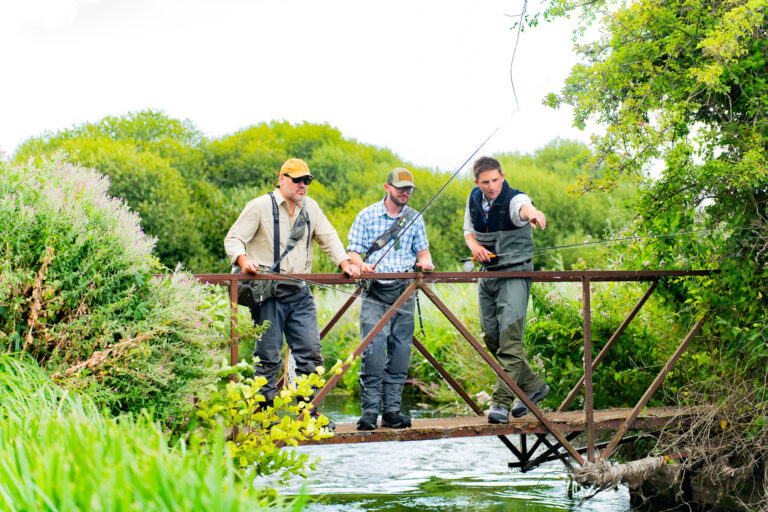
It looks like next week’s going to be a bit nicer, which is good because that leads me on to what we’re doing next Wednesday, which is we’re going to be doing a little bit of filming with Damon Valentine, one of the brilliant filmmakers in Fly
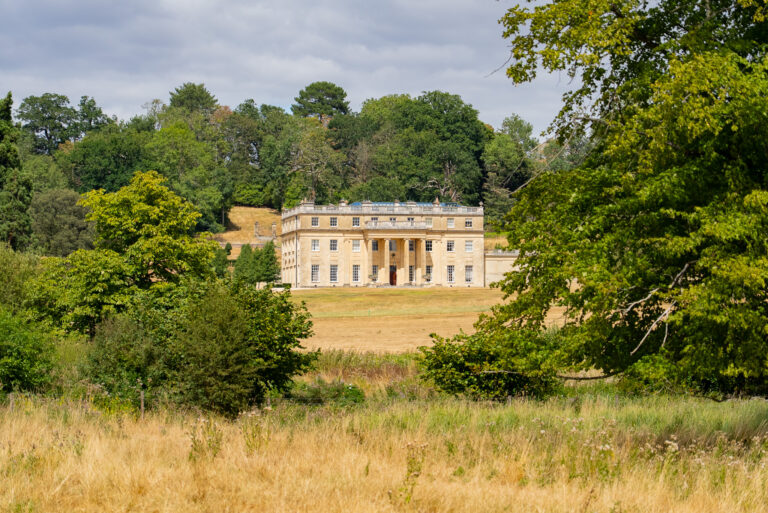
Fishing. So he’s agreed to come up and do a little bit of filming with us next Wednesday. We’re going to be doing that at the famous Mottisfont Abbey, which is what we’re going to talk a little bit about today.
1:31
Mottisfont Fishing and Halfordʼs Hut
So for those of you that don’t know, Wilde Trout now acts as the agent for the fishing at Mottisfont. After a few years of it having laid fallow, there’s been no fishing there for a couple of years.
The National Trust, who are the owners, had been doing a little bit of work. There’s been some restoration work going on there across the four beats.
And only last year, the Wessex Rivers Trust, who are the happy new tenants of the fishing there, had won the tender.
They decided to let it lie fallow, as I say, for another season, just to let things rest and settle in after what had been quite an intensive restoration project.
So it’s all coming good now, though, I think, where last year, we said to the Wessex Rivers Trust, look, why don’t we help you out? We’ll try and sell a little bit of fishing. And we agreed to do that completely for free.
So contrary to what I think most people are probably wondering, we are actually doing this totally in support of the trust. 100% of the profits go to the Wessex Rivers Trust, which I think is really nice.
And so we simply are acting as the agents on behalf of the charity. And we get to do a little bit of guiding as a result of it.
So we’ve got a team of Mottisfont approved fishing guides who know the beach really well and have fished there before and can take people out for the day and hopefully give them some really useful advice.
But the fishing at Mottisfont, I think, is a much change to how many of you might remember it. If you’ve ever fished there in the past, I think it’s important to say that actually the style and difficulty of the fishing is very different.
And so that comes as a result of the restoration project that’s been going on there. And I’m going to leave that little bit of a story to Neil Swift, who’s one of the brilliant project officers in charge of the project at Wessex River Trust.
And so hopefully he’s going to be coming along next week to be my model for some of the filming that we’re doing with Damon.
And he doesn’t know this yet, but I’m going to get him on and try and get him mic’d up with one of these brilliant little mics I’ve got next to me. We’re going to do a little bit of fishing. We’re going to do a little bit of filming.
As is always the way with these films, I’m not actually sure how much fishing will get done. We often just stand there casting without a fly on them.
I’m sorry to steal the magic, but the nature of the beast is such that you can’t really expect to catch one on the day. So often we’re not even fishing, but we might have a little go at the end, who knows.
But yes, I’m going to try and get Neil miked up for that. We’re going to be wading up the river, probably rather awkwardly posing for a few shots, just to get some nice footage for Damon’s little piece that he’s doing for us.
I’m going to try and interrogate Neil for all the information that he has on the work that they do at the Wessex Rivers Trust, but more specifically, the work that they’ve done at Mottisfont. And so that should be a really exciting little piece.
And so I’m looking forward to having our first guest on the podcast in Neil Swift. So just coming back to the fishing at Mottisfont, there’s three beats. There were four, the main is now being sort of lied fallow.
There’s some fishing on the opposite bank, but they won’t be fishing on the Mottisfont side of the river for various reasons. But there’s three beats, the Oakley, the Rectory and the Dunn.
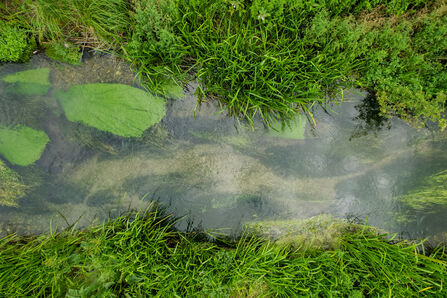
The Dunn is of course the beat on the River Dunn, which is one of the major tributaries to the test. And the Oakley and the Rectory actually run on one of the main sort of channels to the main river.
And so the test at Mottisfont is really split into two main parts, as it is for much of its journey. I mean, it’s very rarely ever in one channel.
In fact, I think the first time it is actually in one channel isn’t until it leaves the town of Romsey, which is a good way into its journey to the sea.
In fact, I think there’s only sort of three to five miles of the river left before it spills out into Southampton Water and the Solent. So the fact that there’s only two channels is actually quite rare.
I mean, normally it’s sort of split up into four or sometimes five little carriers. When you get up above Stockbridge, it’s, I think, in as many as six or seven. So there’s a great deal of different ways you can dice up the test.
But at Mottisfont, we’re fishing a sort of the main carrier to it. The main river is quite a bit larger. The Oakley and the Reptory, as many of you will know, is a little bit smaller in terms of the channel width.
The beets themselves are quite generous in their length, actually. There’s plenty of fishing to keep two or three of you busy for the day. And actually, if there’s four of you going, you’ve got three beets, including the dun, to go and explore.
And so if you’ve booked a day with us this season, there might be up to four of you going as part of your group. You’ve got exclusive use of the three beets, the Oakley, the Reptory and the dun.
And so there’s going to be more than enough to keep you all busy, you know, and especially if you sort of split up as the group, maybe two of you stay on the Oakley, maybe one or two of you nip off to the other beets and perhaps you swap at
lunchtime. There’s plenty of different ways that you can kind of divvy it up. And I think it’s going to be really interesting to see how people decide to do that.
My suggestion would be if you have booked a day or you’re thinking about booking one of the last few days that are available, base yourself at the Oakley Beets.
And that brings me on to the kind of the nature of this podcast today, which is a bit of coverage on what we’ve been doing this week. The Oakley Beet is of course the most famous of the clutch.
And the reason for that primarily is because it is where Halford’s hut is based.
Halford’s hut being the kind of the resting place, as it were, for all of the history and the heritage and the culture that comes with FM Halford and his tenure at Mottisfont. And all the sort of the many writings that came from his time there.
And so what we’ve been doing this week is quite exciting. We’ve been redecorating Halford’s hut. So if you read my newsletter the other day, I said we were just off to go and do it.
And that’s exactly what we did. Two or three of us, Neil and I, and a couple of brilliant helpers came down and we stripped everything out from the inside and redecorated the walls. So it’s kind of brand new lick of paint, two coats.
And it’s looking really smart, actually. I’ll see if I can share a photo. But it was looking a little bit run down before.
It had sort of four or five years of very little use. And with little use comes perhaps a little bit of neglect. But needless to say, it’s back on track.
It’s looking really nice and it’s all sort of freshened up. And at the end of, what week is it now? Where are we?
It’s the 26th of March. So not next week. We’re doing the filming next week.
But the following week, which is a Friday the 10th, we’ve agreed to return and we’re going to kit it out with lots of the old sort of memorabilia of of times gone by. Also some of Halford’s writings and some of his photographs.
So we’re going to do hopefully a really nice job. But we’ve got a couple of people involved who are about as close to FM Halford as one can get. So it’s really good to be involved with a project like this.
And so we’re super excited to see how that kind of unfolds. Now, once we’ve done that on Friday the 10th, the first day that it’s actually going to be fished by someone that’s bought a day is the 13th of April.
So that’s a Monday, it’s the following week. And that’s going to be really exciting. I suspect there’ll be a good hatch of large dark olive around then.
So for them to have had first dibs on the river of the season, it is going to be pretty cool. So fingers crossed they have a great day. And thereafter, the fishing is actually very nearly fully booked for the rest of the season.
It’s only going to be fished three days a week, a Monday, a Wednesday and a Friday. So it’ll remain quite well rested, I hope, for much of the season. It’ll never be fished two days consecutively, which is nice.
I think if you’re turning up and you know that it’s not been fished the day prior, then it’s quite a nice feeling to know that it’s been well rested, isn’t it? And that the fish aren’t going to be too wary.
Particularly when we’re talking about this in the context of a wild fishery. You know, all of the fish that you’re going to be fishing for at Mottisfont, hopefully will be wild.
There will be, I suspect, some fish that have been stocked from downstream, upstream and around the system that have made their way into the river there.
So don’t be too surprised if you catch what we call a stocky, which is usually a larger brown trout.
But for the most part, the fishing has really been catered toward encouraging wild trout populations, both the juvenile populations, but also large wild brown trout as well. And there are some large wild brown trout there.
And in fact, there were a couple of test days that were run last year by Neil and Mike at the Wessex Rivers Trust. And they brought along a couple of guests throughout the season.
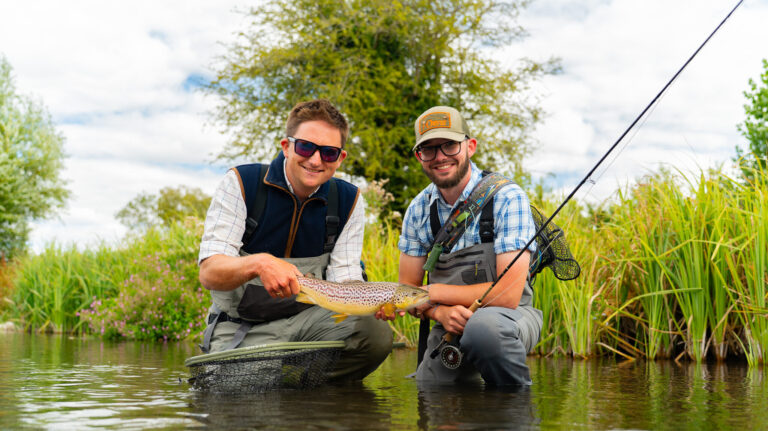
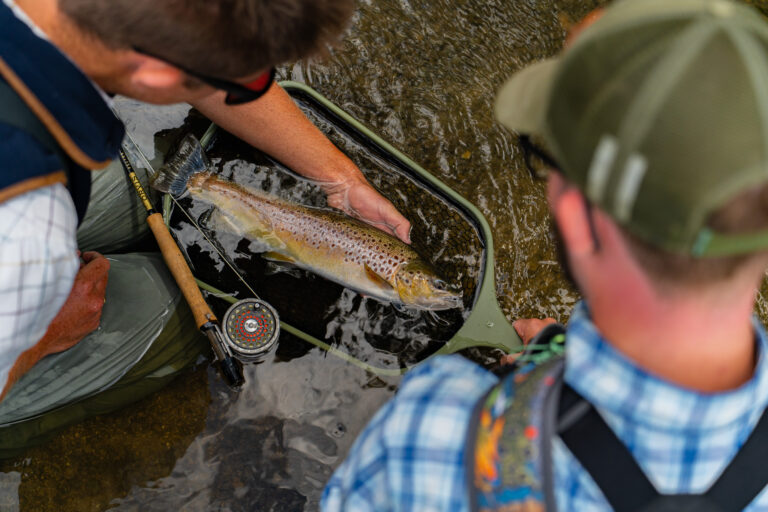
And I think the kind of broader consensus was that actually there was some really quite large wild trout around. And we’ve got some photos of some brilliant looking fish that were caught last summer. So that’s really exciting.
We’ve seen some really large trout in their various lays on the Oakley beat and the Rectory beat as well. So both of those two beats do seem to hold some large fish. The lower part of the Dunn beat also holds some good fish as well.
But I think for the most part, the fishing is really lent towards the smaller wild brown trout fishing. And actually, there’s absolutely loads of those small wild brown trout, particularly in the Rectory and the Dunn beats.
It’s just brimming with these beautiful small fish. And we’ve had some great reports from people that fished during those test days throughout last season. So we’re really excited to see how this year goes.
The first day, as I say, was on the 13th of April. We do have a Mayfly season and all three beats have got form for having an electric Mayfly hatch during the right period. So that’s going to be really exciting as well.
The Mayfly season, as we’ve outlined it, is something like the 12th of May through to the 6th of June. So there would have been a little bit of a price premium for those days during that period.
But of course, that’s not to say we won’t have some Mayfly outside of that period as well. And so I think last year, actually, we did have a really, really good Mayfly hatch somewhere on the middle test, on the 11th of May.
And it just came that little bit earlier, but it was really quite something. It was one of those sort of hatches that you read about, where you just get these black clouds, like gun smoke, of Mayfly drifting over the river.
So it can come a little bit earlier. And in fact, on the Itchin, it does seem to come a bit earlier. The Mayfly hatches there can start as early as the first week of May, and sometimes a little bit earlier.
So I’ve got no kind of worries about people having a good day during the Mayfly period. I’m sure that there’s a really good chance, whichever day that you’ve landed on, I think there’s a really good chance of you seeing some Mayfly during your time.
13:31
Fishing Advice and Guiding Story
My advice to everybody who has booked today, or is thinking about booking one of those last few days, would be don’t rush it. You know, there’s absolutely loads of fishing to keep you and your group busy for the day.
So if you turn up around 10 o’clock in the morning, base yourself at the Oakley Hut. That’s where the teas, the coffees, everything in terms of ample seating, car parking, all of that, everything is at the Oakley beat really.
So my suggestion would be to sort of base yourself there and then you can kind of go off as you please and split your group up whichever way works best for you. But certainly don’t rush it.
You know, take some time, maybe walk the beats first, take some time to work out where fish are holding, what they might be feeding on. And the best fishing, certainly best fly life will be had towards the end of the day.
The sort of late afternoon, early evening is the time really to make sure that you’re on the river. So definitely don’t miss out. I think what we’re trying to get at.
So, you know, there’s, there’s some very prolific fly life that happens within that last couple of hours of light, and particularly as you get later in the year as well.
We get into sort of June and July, that becomes even more important to make the most of those last few hours of the day. All very much to look forward to. It’s still only March.
I’m getting too excited. I need to rein myself in a bit, but there’s still, you know, we’ve still got to wait at least 10 days until we can get on the river from the day that I’m recording this.
Here in Hampshire, the season starts that little bit later. Many of you, I think, around the country, may have even been on the river a little bit earlier, where the regions have different close seasons.
You might have been able to get on the river just that little bit earlier than us. And if you have been out, you’ve probably been enjoying the famous March Brown Hatch in the last few weeks.
I know that there’s been some fantastic, some fantastic reports of some very prolific fly life around the country. So, so that’s exciting.
Unfortunately, though, for us chalk stream lifers, all we can do is sit on our hands, make sure the fly boxes are stocked up and spool up the reels. We’re chomping up the bit, but we can’t do anything.
So that’s, that’s what it’s like in Hampshire at the moment. To be honest with you, I haven’t felt like doing anything this week. The weather’s been pretty rough.
It’s sunny now. But as I say, I mean, we just about had every, every single type of weather under the sun yesterday. It was one of those really strange, moody days that made you feel like you should be in Tenerife or something.
But yes, envious of anybody who’s on holiday at the moment. I think that’s for sure. So next week, we are, as I say, getting on the river with Neil and Damon.
Looking back at the work we did this week at Halfords Hut, we’ve got still some more work to do in terms of actually putting up some of the old artwork and some of the literature.
We’re going to really hopefully make Halfords Hut into the nod to FM Halford that it once was. And I think that’s the real aim is to make the fishing here at Mottisfont much more about the experience than necessarily just about the fishing.
Although the fishing obviously is going to be a really exciting part of it. There’s going to be a couple of good things in the hut. So as I said, there’s going to be tea, coffee making facilities, a kettle and everything that you need.
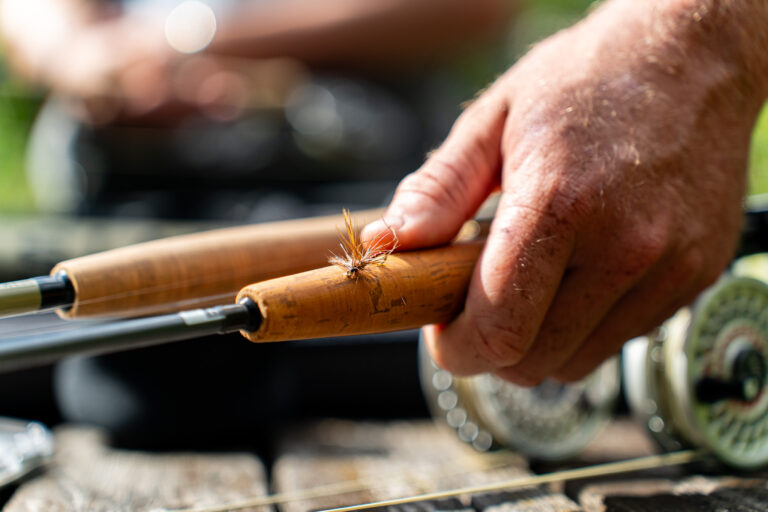
Bring some fresh milk if you are coming. And that’s really all you need. But there’s also going to be a fly tying kit, which we’re quite looking forward to putting together.
There’s going to be a vice and sort of all the basic fly tying equipment that you need so that you’ll be able to sit where Halford once did, maybe go out and check the fly life, bring one back and study it and hopefully tie your own imitation as FM
Halford would once have done himself and then hopefully go out and try and catch a fish on your fly. So if you’d like to try and do that, you’re very welcome.
It’s something that we’re hoping that people will find the time to do during their stay because it’s just a nice little touch.
And we’re hoping that people will actually catch something on the fly that they’ve tied because there’s no better or more fulfilling feeling, I don’t think, than actually catching a fish on your own hand-tied fly.
So, I’m very much looking forward to all of that. As I say, back in the office today, yesterday was a bit of fun, but today we’re back in the office. I’ve got lots of work to do.
I’ve got to go through the diaries, make sure that we haven’t got any cock-ups, so that’s on the list of cards to do. I’m sure it’s all fine, but it’s worth a check. And then we’re all very much looking forward to next Wednesday.
So, I’ve got a big snack of orders on my desk I’ve got to go through as well. So, our online booking system was really tested to the limits a few weeks ago, when we went live with our booking system and live with the fishing at Mottisfont.
We’ve done about a week or so of marketing, a bit of build-up to it and sort of, you know, well, the dates are going to be limited, so make sure you book at 10 o’clock on the night of the archer. And so, we sort of made a big thing out of it.
And it’s clearly worked because so many of you who have booked, booked within that first hour of the diaries being live. And so, I don’t think I’ve ever had so many phone calls in such a short space of time. I had about 20 missed calls.
And goodness knows only how many emails came through at one time. I get an email for every order that comes through, and I was getting duplicates and all sorts coming through.
It was so much happening at once, but it was nice to sort of see that everything was working. And even nicer to know that so many of you are looking forward to trying the new kind of style of fishing at Mottisfont.
So very much looking forward to that. I’m hoping that my chat with Neil next week will shed some light on the reasons why it’s been done and how it’s going to benefit the habitat for wild trout at Mottisfont.
But also what the long term vision is for these sorts of projects and how they actually go about ensuring that these things are sustainable in the long term rather than just, you know, a short term attempt at throwing some wood in a river and hoping
for the best. It’s as somebody that’s known Neil for a little while and sort of been kept up to speed with everything that the Wessex Rivers Trust do, I can tell you, it’s definitely a lot more than that.
So very much looking forward to giving Neil a bit of stick when he gets a fly stuck in the trees. And yes, that’s all to look forward to for next week. Very much looking forward to trying to get some new guests on the podcast as well.
But I’ve got a couple of people lined up that are hoping we can get in over the next few weeks. All to look forward to beyond next week. Obviously the season opens next Wednesday, whenever it is.
And beyond that, we’ve got quite a lot going on. Private tuitions and courses mainly in the short term. I’ve got a day guiding a gentleman on the River Itchin, which I’m really looking forward to.
He’s a really nice chap. I guided him a few times last year, and he texted me a couple of weeks ago and said, are you free just after Easter? He’s one of these people that he can cast really well.
He’s been around the world.
He’s probably been doing it for 35, 40 years longer than I have, so he’s far more experienced than I am, which I always find interesting, trying to guide people like that, because they often have their own ways of doing things.
And to be honest, they know exactly what they’re doing. This chap knows exactly what he’s doing. He’s really good.
But I’ll tell you a story from last summer. We were on the Nadda down near Compton Chamberlain. And he does this thing.
He’s got one of these sort of quirky traits, where he will not play a fish on the line. He’d much prefer to play it on the reel. And for anyone that knows the Nadda, it’s quite narrow, quite deep in places, often quite shallow.
And it’s usually, it’s quite narrow, but it’s got pool, riffle, pool, riffle, pool, riffle. And the pools are often quite deep. The riffles are quite shallow in between.
But that’s the general kind of layout. There’s some kind of quite tight meanders, but it’s generally quite densely overgrown with trees and things like that.
And so if you get a fish, you do have to be careful that it’s not going to, you know, go off and get stuck in a tree root somewhere. So keep that in mind. Anyway, we’re going for this fish in this pool and we can see it rising.
And it’s clearly quite a good fish. And I said, well, just see if you can cast just that little bit further upstream now. Give it a bit of time to think about it.
I can’t remember what fly we were using, but I suspect a blue-winged olive or something to that effect because it was in June, July time.
And I said, right, let’s just cast a little bit further upstream, mend the line back up and let it sort of think about it. Give it a bit of time.
So we went about two, three foot upstream of this fish with the fly and it nestled right in the seam of the water as it was riffling over into the pool. So it was perfect. Fish came up first time and slurped it up.
And it was an electric moment, as it always is. He struck perfectly. I didn’t even need to tell him anything.
You know, it all comes naturally to somebody that’s been doing it as long as this chap has. He struck into it. Perfect.
Now he’s got loads of line out where he’s been casting. He’s been doing a sort of a overhead haul and he’s got loads of line at his feet.
So he’s hooked into this fish and straight away, he’s trying to reel the line back up on to the reel so he can play it from the reel. And I’m thinking, you know, no, no, no, no, no, just concentrate on stripping the line through your fingers.
You can stay in contact with the fish much better that way, in my opinion at least. And he was having none of it. So he was trying to reel this line back up and I was saying, just strip, just strip.
For God’s sake, don’t use the reel. And he carried on trying to replay it on the reel. All of a sudden, in the heat of the moment, the fish goes off on a really hard run.
It’s obviously quite a large trout and it whizzes off upstream. It goes straight up the riffles above the pool that we’d caught it from and into the pool above. It probably stripped 15 to 20 yards of line off him straight away.
And in that moment, his reel dropped off the rod. It fell straight off the rod. So he’s got a rod and a reel in the grass.
So now he was forced to use the line and it was all a bit of a mess. I mean, goodness knows how we got it back. But we did and we did finally land it.
When we went to go and land it, I snapped my net in the weed, tried to scoop it up for him. So it was all a bit hectic, but it was a funny story and I’ll never let him forget it. But we’re going to the itching together on Monday the 6th, I think.
So the first few days of the season, which is going to be really exciting, we’re going to a beat on the main itching, which is a lovely little wading beat. So we’re looking forward to that. I think the fly life should be OK.
I suspect it’ll probably be, you know, this time of year, probably what little fly life there will be as early as April will be large dark olive, maybe some early granum.
But I think we’ll probably be using large dark olive patterns and just see how the day goes. So we’re looking forward to that.
And beyond that, again, back to the sort of the tuitions and courses for much of early April until we get to the middle of April.
When I’ve got a group of four coming down from London, and they’re looking forward to spending a couple of days, they’re doing a private tuition with us on the lakes on one day. And then the next day we’re taking them on to the main river test.
Quite an easy beat, plenty of space, lots of fish. And so hopefully they’ll have a bit of fun doing that. They’re going to stay in Stockbridge and we’ll go pick them up and take them out to the fishing.
So they’re going to have a good bit of fun. And the following week, we’re out filming again. Damon’s coming back for two days, and we’re going to be doing a bit of coverage on all of the work that we do at Wilde Trout, all the work that I do guiding.
And hopefully just have a bit of fun with cameras on the river. Fingers crossed. I’m really hoping that we have some sort of reasonable weather for it with all these things.
You know, whenever you’ve got a camera around you, the pressure is always on. But I’m sort of hoping that, you know, we might get some calm weather. I’m not sure you want it too sunny, otherwise it’s glary on the water.
Mind you, I’m not an expert. I don’t know why I’m going down this rabbit hole. But Damon definitely knows what he’s doing.
So if you haven’t seen his work, you must check him out on Instagram. I think he’s called Wild River Media. He’s done loads of stuff for lots of people and there’s no doubt in my mind that he’s going to do a great job for us.
So very much looking forward to working with him.
26:37
Mayfly Season and River Health
And then that takes us into May. And now I’m really pushing the boat out, I know, but May is shaping up to be a good one.
I think with lots of water in the river, that’s going to mean it’s going to be a good year for the weed, but certainly a pretty promising year for the fly life more than anything. We had a pretty good May fly last year, actually.
The two or three years prior had been a little bit rough. You know, the hatches had been quite sporadic and sparse, and it was difficult to kind of predict what was going to happen.
But last year was really, really good, particularly in the early part of the May fly period. As I say, we had some early hatches on that sort of first weekend of the 11th and the 12th.
And then, of course, by the time you get through to the sort of 20th, that’s prime time, really. Any kind of, you know, 10 days either side of the 20th is about where you want to be.
Generally, you can say that there’s going to be a decent hatch on any day during that period. But it varies so much. The goalposts kind of shift every year.
And as I say, the itching tends to come a week, sometimes two weeks earlier than the test. And the further west you go, it seems to get even later. So you go, the itching comes earlier, test comes a little bit afterwards.
And then if you go further west, the Avon and some of the Wiltshire and Dorset streams, they can carry on long into June and sometimes into July as well. So it is interesting how it works.
I’m not entirely sure why that is, though I suspect it’s something to do with the water quality and the different substrates that sort of characterize the different rivers. But who knows? I’m not an expert.
I’ve got no idea. I’m just hypothesizing. It’s always interesting to see how these things play out every year.
As I say, some years it can be a week different to the year before. But all very much looking forward to that. And then during May, we’ve got quite a bit on.
I’m doing some guiding down on the Frome at Ilzington in Dorset. So that’s going to be really cool. If you’re into your wild fishing, that’s a brilliant bit of fishing down there on the Frome.
There’s some really large trout, but it’s all wild. Sometimes on those sort of street, the backwaters, the streams beside the main river, they’re often much more productive than the main river in itself.
And some of those smaller streams hold some very large trout. So I really enjoy that style of fishing. It’s very narrow.
Deep in place is very shallow in others, but what there is loads of is trees and bushes and undergrowth, shrubbery, everything wants to catch your fly, except the trout.
So it’s a very challenging style of fishing, even more challenging to guide somebody, which is what we’re there for for a few days at the end of May. But very much looking forward to it. It’s always good fun.
Yeah, we’re hopeful of a good Mayfly hatch there as well. In fact, it often comes later again, that being so much further west than where we currently are in Hampshire. Those Dorset streams often do better long into June for the Mayfly hatches.
But there’s always good fly life of other things, Hawthorne, Granham, large dark olive, particularly when you get into June, blue-winged olive. So lots to look forward to and, as I say, it’s a really enjoyable, challenging bit of fishing down there.
Beyond that, back to normal again with lots of private tuitions and courses and the various guiding experiences on the chalk streams across the Hampshire, Wiltshire and Dorset rivers. Yeah, lots going on.
I think it’s going to be a good season all round in terms of having enough water in the river. That’s always a good sign. And as I said earlier, I think it’s shaping up to be a pretty big one for the weed.
I know that lots of the river keepers will probably be thinking the same thing. Lots of water is almost always kind of conducive to having lots of weed in the river.
So that means your ranunculus, your water parsnip, ribbon weeds, watercress, all of these things that the river keepers will be out there in June, cutting from the river, trying to get some sunlight back into the river and just try and keep on top of
it. The good thing about the weed, as many of you will know, is that it actually acts as an impoundment to the water and holds lots of water back in the system. As soon as you cut it out, you actually let quite a bit of water go.
And so it’s a fine balance between cutting enough out so that you let some light into the river and allow things to continue succeeding and also make things accessible to the fishing, but also try and hold enough water back in the system so that when
we get into the late summer months and things are really dry and we’re sort of low on water in the system, when the aquifers have been over-obstracted and exploited to the nth degree come sort of late July, August time, that’s when you start
thinking, actually, if we cut a little bit less weed, we could hold a bit more water back in the rivers and they’d be all the better for it. But having lots of water in the river right now is really important. So I know that lots of the river
keepers, although the banks are wet and they won’t get their mowers along it, I suspect lots of the river keepers will be very pleased indeed. keepers, although the banks are wet and they won’t get their mowers along it, I suspect lots of the river
31:57
Future Guests and Outlook
keepers will be very pleased indeed. So lots to look forward to this season. Lots to look forward to in the short term as well with everything going on next week. And a lot to look forward to on the podcast.
So like I say, Neil doesn’t know it, he’s coming on the podcast next week. And beyond that, we’ve got lots of exciting guests teed up for the weeks thereafter.
So we’re really looking forward to trying to take this podcast further every time with new and exciting and interesting guests so that you don’t have to listen to me so much as you have done today.
But hopefully, I could say in future episodes, we’re going to have some brilliant guests on board and it’s going to be really exciting to see where we can take this.
Like I say as always, if you’ve got any ideas about who you’d like to have on board and who you’d like to listen to, do give me a shout.
I’m always delighted to see if we can speak to new people and work out whether it’s something they’d be interested in talking about, whether they’ve got a role in the industry or a particular story that they love to tell.
Whatever it is, we’d like to speak to them. So do get in touch and let us know if you know somebody or perhaps you yourself would like to come on board the podcast. I’d be delighted to have a chat.
So thanks very much for listening. That’s all I’ve got time for this week. I’ve got a really busy day today.
I’ve been sat here for 40 minutes. I’m looking at the clock and I’m thinking, my goodness, I’ve got about 40 emails to send in a minute. So wish me luck.
But looking forward to the weather improving next week. So hopefully I’ll be able to get out of the office again. There’s only so long I can sit in this chair.
I know that many of you will be the same, itchy feet, but anyway. So very much looking forward to having you back next week when we will be speaking to Neil Swift and Damon Valentine.
And beyond that, thanks very much for listening and we’ll speak to you next time.